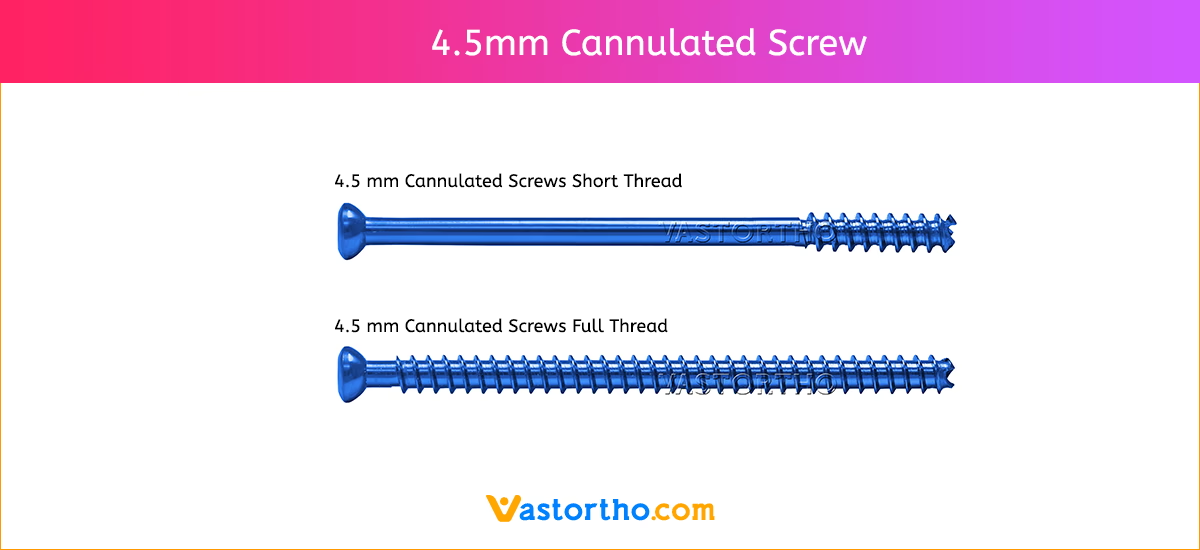
3.5mm Cannulated Screw – Precision 3.5mm Cannulated Cancellous Screw for Small-Joint Osteosynthesis

Bone-Conserving Ø 1.2mm Guide-Wire Targeting, Self-Drilling Tri-Fluted Tips, and Low-Profile Spherical Head Geometry for Delicate Upper-Extremity, Midfoot, Forefoot, and Pediatric Fracture Fixation.

Designed for Level I/II hospital trauma centers, hand and wrist units, foot and ankle specialists, and global orthopedic distributors, our 3.5mm Cannulated Screw bridges the biomechanical gap between micro headless pins and standard 4.0mm small-fragment screws. Manufactured directly under ISO 13485:2016 quality systems in both Ti-6Al-4V  Titanium and 316LVM Surgical Stainless Steel, this compact 3.5mm Cannulated Cancellous Screw minimizes cortical displacement and prevents iatrogenic fragment splitting across narrow subchondral corridors.

  • Ultra-Compact Ø 2.7mm Core Geometry: Preserves critical bone stock inside small articular fragments (radial head, carpal bones, tarsal navicular, and metatarsal bases) while maintaining torsional and bending rigidity over a Ø 1.2mm guide wire.
  • Two Dedicated Thread Configurations: Supplied in Short Thread and Full Thread profiles across 10mm to 50mm lengths (2mm increments) to handle both dynamic lag compression and static positional fixation.
  • Streamlined Percutaneous Workflow: Engineered for a predictable, fluoroscopy-guided 3.5mm cannulated screw surgical technique with sharp self-drilling, self-tapping distal flutes and reverse-cutting back threads for straightforward late-stage removal.
  • Low-Profile Ø 6.0mm Head & Ø 7.0mm Washer Compatibility: Minimizes subcutaneous hardware prominence beneath thin dorsal foot, wrist, and ankle soft tissues while mating smoothly with Ø 7.0mm flat cortical washers in osteoporotic bone.
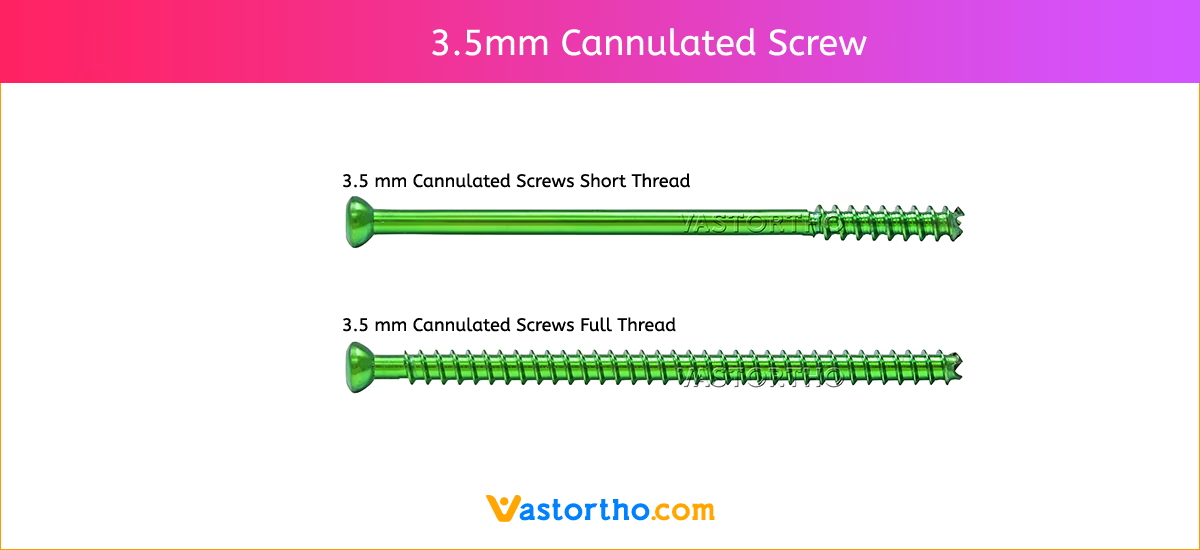
3.5mm Cannulated Screw in Short Thread and Full Thread configurations for small bone fixation

Technical Specifications (3.5mm Cannulated Screw)

Mechanical & Dimensional Specifications

Major Thread Diameter3.5 mm
Core / Minor Diameter2.7 mm
Recommended Guide WireØ 1.2
Recommended Cannulated Drill BitØ 2.7
Drive Recess2.5 mm Internal Hexagonal
Head Diameter & Profile6.0 mm Low-Profile Hemispherical
Compatible WasherØ 7.0 mm Flat Low-Profile Washer
Length Range & Increments10 mm to 40 mm (2 mm increments)
Biocompatible Material StandardsTitanium and Stainless Steel

Thread Configuration Matrix

Thread ConfigurationLength Range (2 mm Steps)Primary Clinical Use
Short Thread10 mm – 40 mmMidfoot arthrodesis & broader cancellous grip
Full Thread10 mm – 40 mmLisfranc stabilization & positional length hold
Ø 7.0 mm Flat Washer1 mm ThicknessThin metaphyseal cortical load distribution
Ø 1.2 mm Threaded Guide Wire150 to 225 mm LengthCoaxial trajectory targeting (Single-Use)

Small-Bone Percutaneous Biomechanics: The 3.5mm Cannulated Cancellous Screw Advantage

Small periarticular and tarsal/carpal fragments present a difficult mechanical trade-off: standard 4.0mm or 4.5mm bone screws frequently occupy too much cross-sectional area, risking fragment comminution or articular cartilage breach, whereas smooth K-wires fail to generate interfragmentary compression and permit rotational loss of reduction.

Our 3.5mm Cannulated Cancellous Screw resolves this challenge through coaxial wire-guided placement. By provisionally stabilizing the reduced fracture with calibrated Ø 1.2mm guide wires under C-arm fluoroscopy first, surgeons confirm exact subchondral clearance before committing to screw insertion. Once seated, the deep-cut 1.2mm cancellous thread pitch anchors firmly inside small metaphyseal beds while preserving the fragile periosteal blood supply critical for scaphoid, navicular, and epiphyseal healing.

Precision Implant Engineering & Thread Architecture of the 3.5mm Cannulated Screw

Every dimensional detail of our 3.5mm Cannulated Screw is CNC machined to micron-level concentricity so the implant glides freely over Ø 1.2mm guide wires without cold-welding, binding, or driver cam-out:

  • Tri-Fluted Self-Drilling & Self-Tapping Tip: Three sharp cutting flutes clear bone chips ahead of the leading thread, reducing operative steps in soft cancellous bone and lowering thermal necrosis risk during insertion.
  • Reverse-Cutting Proximal Thread Flutes: Precision-ground reverse cutting edges on the proximal side of the thread block allow clean, bone-sparing back-out during planned pediatric physeal removal or revision arthrodesis.
  • Short Thread & Full Thread Selection: Short Thread: Keeps all threads strictly distal to the fracture line in small avulsion or articular fragments for maximal lag compression. Full Thread: Resists axial shortening and shear displacement in comminuted Lisfranc injuries or positional stabilization constructs.
  • 2.5mm Hex Recess: Deeply broached internal drive geometry maintains positive screwdriver retention during percutaneous insertion, preventing recess stripping in dense subchondral bone.
  • Low-Profile Spherical Head with Optional Ø 7.0mm Washer: The smooth 6.0mm hemispherical head sits flush against countersunk cortical portals—reducing tendon irritation—while pairing cleanly with a 1mm-thick Ø 7.0mm flat washer whenever thin metaphyseal bone requires broader load distribution.

Clinical Indications: Small-Joint, Extremity & Pediatric Applications

Configured specifically for narrow osseous corridors and low-volume articular fragments, the 3.5mm Cannulated Screw supports a wide range of upper-extremity, foot/ankle, and pediatric orthopedic procedures:

Upper Extremity, Foot & Ankle, and Pediatric Osteosynthesis

  • Hand, Wrist & Elbow Trauma: Radial head and neck fractures, radial and ulnar styloid avulsions, distal humeral capitellar shear fractures, carpal fractures (scaphoid, capitate, hamate), and partial wrist arthrodesis.
  • Midfoot & Forefoot Reconstruction: Lisfranc tarsometatarsal (TMT) fracture-dislocations, tarsal navicular and cuboid fractures, first metatarsophalangeal (MTP) arthrodesis, Weil/chevron forefoot osteotomies, and fifth metatarsal base fractures.
  • Ankle & Distal Tibia Small Fragments: Small medial malleolus avulsions, anterolateral Tillaux fragments, and small posterior malleolar rims where a 4.0mm screw risks cortical splitting.
  • Pediatric Trauma & Physeal Preservation: Percutaneous fixation of pediatric medial epicondyle avulsions, lateral humeral condyle fractures, and small epiphyseal injuries where minimizing transphyseal cross-sectional area is essential.

Step-by-Step 3.5mm Cannulated Screw Surgical Technique

A standardized, reproducible 3.5mm cannulated screw surgical technique minimizes C-arm radiation exposure and ensures accurate subchondral screw length selection. All steps are performed coaxially using calibrated small-fragment cannulated instrumentation:

  • Anatomical Reduction & Ø 1.2mm Guide-Wire Placement: Achieve anatomical reduction via closed manipulation or pointed reduction forceps. Using the coaxial wire protection sleeve, advance a calibrated Ø 1.2mm threaded-tip guide wire across the fracture plane under bi-planar fluoroscopy. Confirm wire trajectory, articular clearance, and temporary rotational stability (adding a second anti-rotation wire if required).
  • Direct Depth Measurement: Slide the direct-read Cannulated Depth Gauge over the Ø 1.2mm guide wire until its tip seats flush against the near cortex. Read the exact screw length in millimeters directly off the proximal end of the calibrated wire. Subtract 2mm if significant interfragmentary lag compression or countersinking is anticipated.
  • Coaxial Near-Cortex Drilling & Countersinking: Place the Ø 2.5mm drill protection sleeve over the guide wire to shield surrounding tendons and neurovascular structures. Pre-drill the near cortex—and across the fracture corridor in dense bone—using the Ø 2.5mm cannulated twist drill bit under fluoroscopic control so the guide wire does not advance inadvertently. Bevel the cortical entry portal using the 3.5mm cannulated countersink to seat the 6.0mm head flush (omit countersinking if using a Ø 7.0mm washer).
  • Cancellous Bone Tapping (Dense Bone Only): Although our 3.5mm Cannulated Cancellous Screw features self-drilling, self-tapping flutes, pre-tapping the near cortex with a Ø 3.5mm cannulated bone tap is recommended in dense, non-osteoporotic cortical bone (such as the tarsal navicular or radial shaft) to minimize insertion torque.
  • Coaxial Screw & Washer Insertion: Load the selected 3.5mm Cannulated Screw (with an optional Ø 7.0mm flat washer if the near cortex is thin) onto the 2.5mm Hex cannulated screwdriver with holding sleeve. Advance the implant coaxially over the Ø 1.2mm guide wire by hand until full interfragmentary compression is achieved. Ensure all threads of a partially threaded lag screw completely clear the fracture line.
  • Final Fluoroscopic Verification & Guide-Wire Removal: Confirm anatomical compression, flush head seating, and absence of intra-articular screw penetration across AP, lateral, and oblique fluoroscopic views. Withdraw and discard the single-use Ø 1.2mm guide wire cleanly using the wire collet or power chuck.

Biocompatible Metallurgy, Sterility & Direct OEM Factory Supply

Sourcing small-diameter cannulated implants directly from an ISO 13485:2016 certified factory ensures exact concentricity between the 1.4mm internal bore and external thread crests—eliminating thin-wall shear failure during high-torque insertion.

  • Medical-Grade Titanium Alloy: Anodized (Type II/III) for instant intraoperative diameter recognition, minimal MRI distortion around small joints, zero nickel-sensitivity risk, and high fatigue endurance.
  • Implant-Grade Stainless Steel: Vacuum-melted, electropolished, and passivated for maximum torsional stiffness and cost-effective procurement across high-volume trauma hospitals and public tenders.
  • Sterile & Non-Sterile Supply Flexibility: Available in ready-to-use, Gamma-Sterilized double-barrier blister packs (5-year shelf life with peel-off stickers) or Non-Sterile individually pouched bulk units designed for hospital caddy loading and pre-vacuum steam autoclaving (132°C / 270°F) for 4 minutes).
  • Complete OEM & Global Tender Compliance: Manufactured in an ISO 13485:2016 certified facility with CE Marking and custom private-label branding for orthopedic distributors worldwide.

Frequently Asked Questions

Q1: When should a surgeon select a 3.5mm Cannulated Screw instead of a 4.5mm Cannulated Screw?

The 3.5mm Cannulated Screw is preferred for delicate, narrow anatomical corridors—such as radial head fragments, carpal bones, tarsal naviculars, Lisfranc joints, and pediatric elbow avulsions—where its smaller 2.1mm core and 6.0mm head prevent fragment splitting and subcutaneous prominence.

Q2: What thread options are available for the 3.5mm Cannulated Cancellous Screw?

Our 3.5mm Cannulated Cancellous Screw is supplied in Short Thread for narrow distal fragment lag compression and Full Thread for deeper cancellous purchase in midfoot fusions and shear-resistant positional fixation across 10mm to 40mm lengths.

Q3: What guide wire and drill bit are required for the 3.5mm cannulated screw surgical technique?

The standard 3.5mm cannulated screw surgical technique utilizes a calibrated Ø 1.2mm threaded-tip guide wire, a Ø 2.5mm cannulated twist drill bit, a 3.5mm cannulated countersink, and a 2.5mm Hex cannulated screwdriver.

Q4: Are your 3.5mm Cannulated Screws compatible with existing universal 3.5mm/4.0mm AO cannulated instrument sets?

Yes. Because our 3.5mm Cannulated Screw adheres to universal Ø 1.2mm guide-wire and 2.5mm Hex drive specifications, it integrates seamlessly with standard international small-fragment cannulated trays as well as our factory-matched sterilization instrument sets.

Q5: Can distributors and hospitals order the 3.5mm Cannulated Screw in both pre-sterile blister packs and OEM private-label caddies?

Yes. We supply both validated gamma-irradiated single-peel sterile blister packs and non-sterile bulk implants and flexible OEM private-label laser branding and sterile packaging customization.

Do you have any questions for 3.5mm Cannulated Screw?
Please fill this form we will get in touch with you shortly.

This field is for validation purposes and should be left unchanged.
Name(Required)

More Products from Cannulated Cancellous Screws

Partner Directly with a Certified 3.5mm Cannulated Screw Manufacturer

Request a formal quotation or inquire about OEM private-label production for our 3.5mm Cannulated Screw.

PRODUCTS

CATALOGUE

COMPANY

Vast Ortho Footer Logo white

Orthopedic implants and surgical instruments. Twenty years of manufacturing experience, serving professional buyers in international markets.

© Vast Ortho:
Orthopedic Implants & Surgical Instruments Manufacturer
First Floor, Khasra No. 104/14 | B-Block, Sant Nagar, Burari | Delhi-110084, INDIA