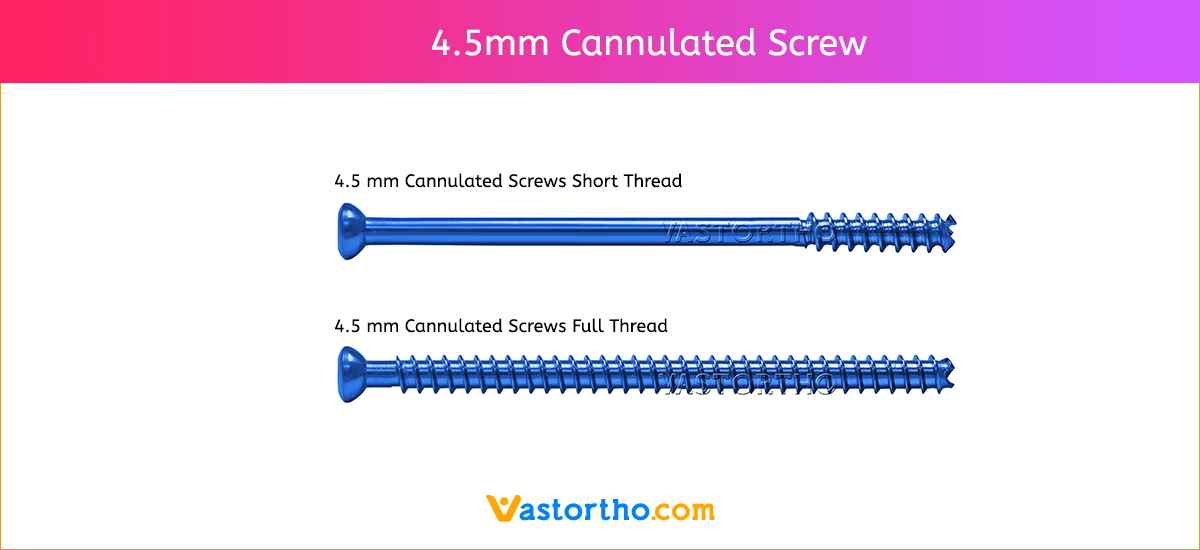
4mm Cannulated Screw – Universal 4.0mm Cannulated Cancellous Screw for Small-Fragment Osteosynthesis

Deep-Pitch Cancellous Thread Purchase, Rigid Ø 2.7mm Core Bending Strength, and Extended 14mm to 70mm Length Coverage for Medial Malleolus, 5th Metatarsal Jones, Wrist, and Pediatric Fracture Fixation.

Recognized across Level I/II trauma centers, foot and ankle clinics, pediatric orthopedic hospitals, and global medical distributors as the foundational small-fragment percutaneous lag implant, our 4mm Cannulated Screw delivers reliable interfragmentary compression across metaphyseal and epiphyseal bone. Engineered directly by an ISO 13485-certified 4mm Cannulated Screw Manufacturer, this universal 4.0mm Cannulated Cancellous Screw is machined from biocompatible Ti-6Al-4V Titanium and 316LVM Surgical Stainless Steel and pairs directly with our dedicated 4mm Cannulated Screw Instrument Set.

  • High-Purchase Cancellous Thread Pitch: Deep, asymmetric cancellous threads maximize axial pull-out strength in osteopenic distal tibial metaphyses, hindfoot tarsals, and pediatric epiphyses.
  • Comprehensive 14mm to 70mm Length Span: Covers short carpal and distal radial fractures in 2mm increments (14mm–50mm) alongside extended 5mm increments (50mm–70mm) for intramedullary 5th metatarsal Jones fixation and long oblique medial malleolar corridors.
  • Two Dedicated Thread Profiles: Available in Short Thread and Full Thread configurations so surgeons can select dynamic lag compression or static positional length maintenance.
  • Fluoroscopy-Guided Percutaneous Efficiency: Designed around a reproducible 4mm Cannulated Screw Surgical Technique utilizing calibrated Ø 1.2mm guide wires, self-drilling tri-fluted tips, and reverse-cutting back flutes for smooth late-stage removal.
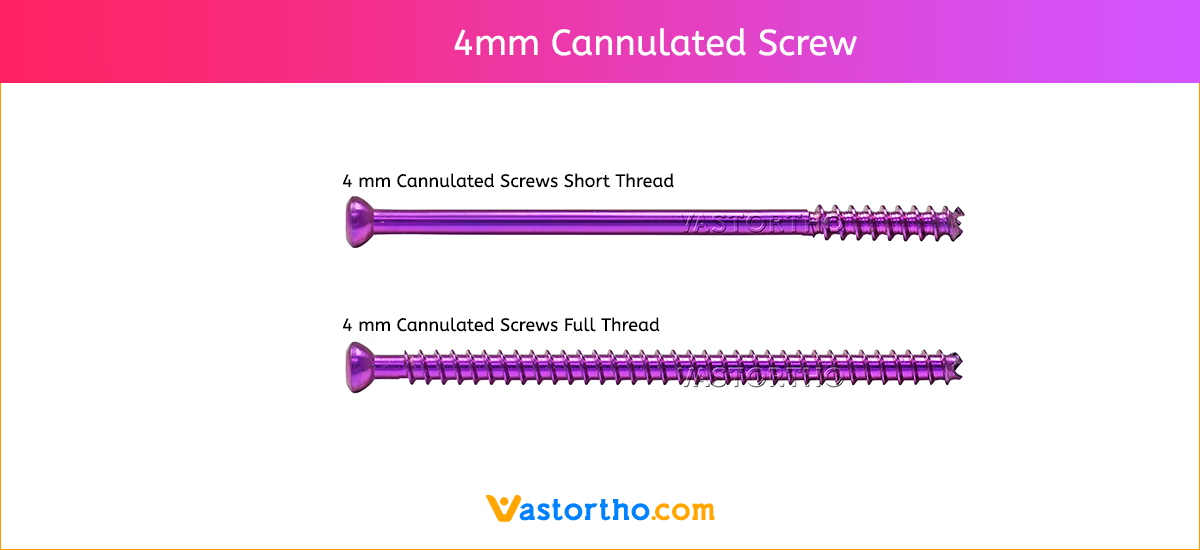
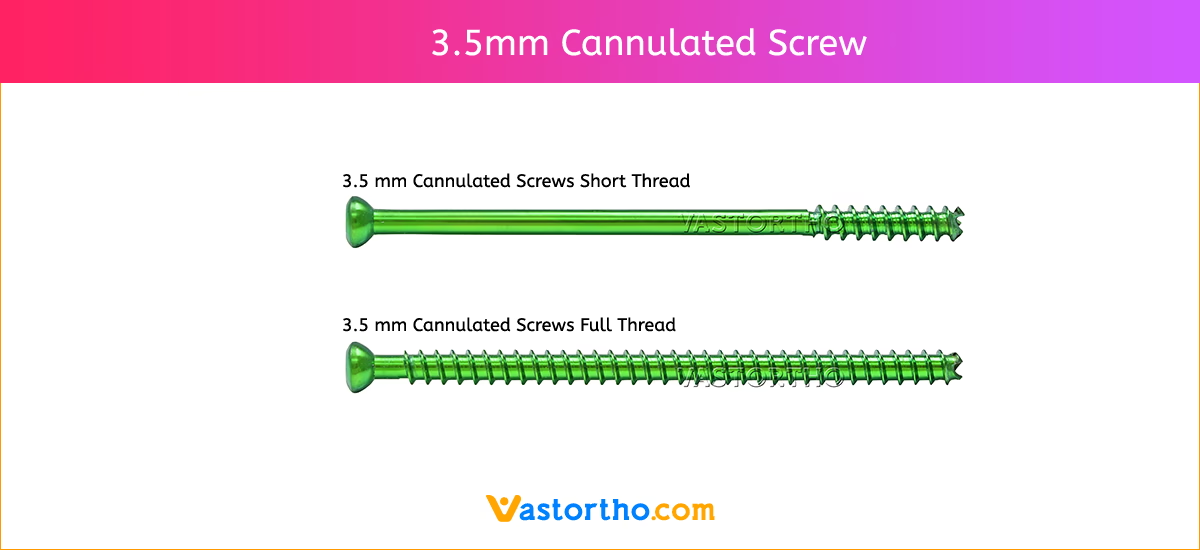
Complete 4mm Cannulated Screw lineup in Short Thread and Full Thread designs with 7.0mm washer for medial malleolus fixation

Technical Specifications (4mm Cannulated Screw)

Mechanical & Dimensional Specifications

Major Thread Diameter4 mm
Core / Minor Diameter2.7 mm
Recommended Guide WireØ 1.2 mm
Recommended Cannulated Drill BitØ 2.7 mm
Drive Recess2.5 mm Internal Hexagonal
Head Diameter & Profile6.0 mm Low-Profile Hemispherical
Compatible WasherØ 7.0 mm Flat Low-Profile Washer
Length Range & Increments14 mm – 50 mm (2 mm steps); 50 mm – 70 mm (5 mm steps)
Biocompatible Material StandardsTitanium and Stainless Steel

Thread Configuration Matrix

Thread ConfigurationLength Range (2 mm Steps)Primary Clinical Use
Short Thread14 mm – 70 mmMedial malleolus & distal tibia lag compression
Full Thread50 mm – 70 mmIntramedullary 5th metatarsal Jones & midfoot fusion. Pediatric epiphysiodesis & positional stabilization
Ø 7.0 mm Flat Washer1 mm ThicknessCortical load distribution in osteoporotic malleoli
Ø 1.2 mm Threaded Guide Wire150 to 225 mm LengthCoaxial trajectory targeting (Single-Use)

Small-Fragment Metaphyseal Biomechanics: The 4.0mm Cannulated Cancellous Screw Standard

Ankle, foot, and pediatric epiphyseal fractures demand high interfragmentary compression to achieve anatomical joint congruity while operating directly beneath thin, poorly vascularized subcutaneous soft-tissue envelopes. Open plating or oversized large-fragment hardware in regions like the medial malleolus or proximal fifth metatarsal frequently triggers wound-healing complications and hardware prominence requiring secondary removal.

Our 4.0mm Cannulated Cancellous Screw delivers the optimal mechanical ratio between thread purchase and soft-tissue preservation. By stabilizing the reduced fracture provisionally with Ø 1.2mm calibrated guide wires under C-arm fluoroscopy first, orthopedic trauma surgeons verify joint-surface clearance and parallel screw spacing prior to drilling. The reinforced Ø 2.6mm core provides higher cyclic fatigue resistance than 3.5mm constructs—making it durable enough for intramedullary 5th metatarsal weight-bearing loads—while the low-profile 6.0mm spherical head sits unobtrusively beneath the medial ankle skin.

Precision Implant Engineering & Thread Architecture of the 4mm Cannulated Screw

Every dimensional feature of our 4mm Cannulated Screw is Swiss-CNC machined to tight coaxial tolerances so the central 1.4mm lumen tracks smoothly over calibrated Ø 1.2mm guide wires without binding or deflecting:

  • Deep-Cut 1.6mm Asymmetric Buttress Threads: Optimized specifically for trabecular cancellous bone, generating strong axial pull-out resistance across the tibial plafond, talus, and metatarsal diaphysis.
  • Self-Drilling & Self-Tapping Tri-Fluted Tip: Three razor-sharp distal cutting flutes initiate smoothly into cancellous bone, reducing operative time and minimizing thermal necrosis during insertion.
  • Reverse-Cutting Proximal Flutes: Precision-ground flutes on the trailing edge of the thread block cut backward cleanly through healed cortical bone during planned pediatric hardware removal or revision surgery.
  • Short Thread & Full Thread Selection: Short Thread: Keeps all threads strictly distal to the fracture plane for maximal lag compression in narrow medial malleolus and Tillaux fragments. Full Thread: Delivers shear-resistant positional stability for pediatric transphyseal hemiepiphysiodesis and comminuted metaphyseal fractures where shortening must be prevented.
  • Low-Profile Hemispherical Head & Ø 7.0mm Washer Interface: Broached with a deep 2.5mm Internal Hex recess to eliminate driver cam-out, and contoured to mate cleanly with a Ø 7.0mm flat cortical washer whenever osteoporotic bone requires broader load distribution.

Clinical Indications: Ankle, Foot, Upper-Extremity & Pediatric Applications

Serving as the highest-volume small-fragment cannulated screw in orthopedic trauma practice, the 4mm Cannulated Screw supports a broad spectrum of percutaneous and mini-open procedures:

Ankle, Foot, Elbow & Pediatric Osteosynthesis

  • Ankle & Distal Tibia Fractures: Parallel twin-screw lag compression of medial malleolus fractures, posterior malleolar fragments, syndesmotic avulsions, and adolescent Tillaux or triplane fractures.
  • Foot & Metatarsal Trauma: Axial intramedullary screw fixation of acute and delayed-union Zone II/III 5th metatarsal (Jones) fractures, Lisfranc injuries, tarsal navicular fractures, and midfoot arthrodesis.
  • Upper-Extremity & Periarticular Fractures: Distal humeral trochlear and capitellar reconstructions, olecranon tension-band augmentation, glenoid rim fixation, and scaphoid/carpal nonunions in larger-stature patients.
  • Pediatric Limb Deformity & Epiphyseal Trauma: Percutaneous transphyseal screw hemiepiphysiodesis for angular knee or ankle deformity correction, plus displaced pediatric medial epicondyle and distal femoral/tibial epiphyseal fractures.

Step-by-Step 4mm Cannulated Screw Surgical Technique

Following a standardized 4mm Cannulated Screw Surgical Technique maximizes interfragmentary compression while protecting adjacent neurovascular structures and articular cartilage. All steps utilize coaxial small-fragment instrumentation from our 4mm Cannulated Screw Instrument Set:

  • Fracture Reduction & Ø 1.2mm Guide-Wire Placement: Reduce the fracture anatomically using closed manipulation or pointed Weber reduction clamps. Insert a calibrated Ø 1.2mm threaded-tip guide wire through the coaxial soft-tissue protection sleeve across the fracture plane under bi-planar C-arm fluoroscopy. For medial malleolus or multi-screw cases, utilize the Parallel Wire Guide to place a second parallel Ø 1.2mm guide wire to control rotation and maximize construct stability.
  • Direct-Read Guide-Wire Depth Measurement: Slide the calibrated Cannulated Depth Gauge over the Ø 1.2mm guide wire until the distal tip rests firmly against the near cortex. Read the exact millimeter screw length directly off the proximal calibrated wire mark. Deduct 2mm to 4mm if substantial interfragmentary gap closure or cortical countersinking is planned.
  • Coaxial Ø 2.7mm Drilling & Cortical Countersinking: Advance the coaxial Ø 2.7mm drill sleeve onto the bone surface to shield tendons and cutaneous nerves. Pre-drill the near cortex—and across dense medullary corridors such as the 5th metatarsal canal—using the Ø 2.7mm cannulated twist drill bit while verifying under fluoroscopy that the guide wire does not migrate distally. Use the 4.0mm cannulated countersink to recess the near cortex for flush head seating (skip countersinking if deploying a Ø 7.0mm washer).
  • Optional Cancellous Bone Tapping (Dense Bone): While our 4.0mm Cannulated Cancellous Screw is self-drilling and self-tapping, pre-tapping dense cortical zones (such as the fifth metatarsal diaphyseal isthmus or young cortical bone) with a Ø 4.0mm cannulated bone tap reduces insertion torque and eliminates risk of iatrogenic shaft splitting.
  • Coaxial Screw & Ø 7.0mm Washer Insertion: Mount the selected 4mm Cannulated Screw (pre-loaded with a Ø 7.0mm flat washer if the near cortex is osteoporotic) onto the 2.5mm Hex cannulated screwdriver with retaining sleeve. Drive the screw smoothly by hand over the guide wire until full cortical contact and interfragmentary compression are achieved. Confirm that all threads of a partially threaded lag screw completely clear the fracture line.
  • Final Fluoroscopic Check & Guide-Wire Removal: Verify anatomical reduction, compression across the fracture line, flush head seating, and absence of intra-articular hardware breach across AP, mortise, and lateral fluoroscopic projections. Extract and discard the single-use Ø 1.2mm guide wire cleanly.

Biocompatible Metallurgy, Sterility & Direct OEM Supply: Certified 4mm Cannulated Screw Manufacturer

Sourcing small-fragment cannulated implants directly from an ISO 13485-certified 4mm Cannulated Screw Manufacturer eliminates multi-tier broker markups and guarantees the micron-level bore concentricity and thread flank accuracy required for trouble-free intraoperative insertion. Deep-hole gun-drilling and thread whirling on 70mm-long 4.0mm shafts require tight statistical process control so screw heads never shear and guide wires never bind during power drilling.

Medical-Grade Titanium Alloy: Finished with controlled Type II/III anodizing for instant intraoperative diameter recognition, lower elastic modulus closer to human bone, zero nickel-allergy risk, and minimal postoperative MRI distortion.

Implant-Grade 316LVM Stainless Steel: Vacuum-melted, electropolished, and passivated to deliver maximum bending stiffness for intramedullary Jones fractures and cost-effective pricing for high-volume trauma hospitals and public health tenders.

Sterile & Non-Sterile Supply Flexibility: Available in ready-to-use, Gamma-Sterilized double-barrier blister packs (5-year shelf life with peel-off stickers) or Non-Sterile individually pouched bulk units designed for hospital caddy loading and pre-vacuum steam autoclaving (132°C / 270°F) for 4 minutes).

Complete OEM & Global Tender Compliance: Manufactured in an ISO 13485:2016 certified facility with CE Marking and custom private-label branding for orthopedic distributors worldwide.

Frequently Asked Questions

Q1: Are your 4mm Cannulated Screws compatible with universal AO small-fragment cannulated instrument trays?

Yes. Our 4mm Cannulated Screw adheres to universal Ø 1.2mm guide-wire, Ø 2.7mm cannulated drill, and 2.5mm Hex drive specifications—ensuring full compatibility with standard hospital small-fragment trays as well as our factory-matched 4mm Cannulated Screw Instrument Set.

Q2: How do surgeons choose between Short Thread and Full Thread on a 4.0mm Cannulated Cancellous Screw?

For narrow distal fragments such as medial malleolus fractures, Short Thread ensures all threads cross completely beyond the fracture gap to generate lag compression. Full Thread provides deeper cancellous engagement in broader midfoot fusions or 5th metatarsal Jones fractures and maintains length and resists axial collapse in pediatric epiphysiodesis or comminuted fractures.

Q3: What guide wire and drill bit are required for the 4mm Cannulated Screw Surgical Technique?

The standard 4mm Cannulated Screw Surgical Technique uses a calibrated Ø 1.2mm threaded-tip guide wire, a Ø 2.7mm cannulated twist drill bit inside a coaxial soft-tissue protection sleeve, a 4.0mm cannulated countersink, and a 2.5mm Hex cannulated screwdriver.

Q4: Should a Ø 7.0mm washer be used with a 4mm Cannulated Screw in medial malleolus fractures?

Yes. When fixing medial malleolus fractures in elderly or osteoporotic patients, pairing the 4mm Cannulated Screw with a Ø 7.0mm flat cortical washer distributes compressive forces over a wider bony surface area and prevents the low-profile head from sinking into the thin malleolar cortex.

Q5: As a 4mm Cannulated Screw Manufacturer, do you offer OEM private-label sterile packs and custom length assortments?

Yes. As a direct 4mm Cannulated Screw Manufacturer, we support orthopedic implant brands, regional distributors, and government tender winners with custom laser-etched brand logos, bespoke anodized color-coding, private-label gamma-sterile blister packs, and custom-loaded hospital implant caddies.

Do you have any questions for 4mm Cannulated Screw?
Please fill this form we will get in touch with you shortly.

This field is for validation purposes and should be left unchanged.
Name(Required)

More Products from Cannulated Cancellous Screws

Partner Directly with a Certified 4mm Cannulated Screw Manufacturer

Request a formal quotation or inquire about OEM private-label production for our 4mm Cannulated Screw.

PRODUCTS

CATALOGUE

COMPANY

Vast Ortho Footer Logo white

Orthopedic implants and surgical instruments. Twenty years of manufacturing experience, serving professional buyers in international markets.

© Vast Ortho:
Orthopedic Implants & Surgical Instruments Manufacturer
First Floor, Khasra No. 104/14 | B-Block, Sant Nagar, Burari | Delhi-110084, INDIA