Titanium Elastic Nail Instrument Set – Complete TENS Nail & ESIN Instrument System

Precision-Engineered Physeal-Sparing Canal Entry, Symmetrical Nail Contouring, Controlled Impaction, and Flush Beveled Cutting Instrumentation for Pediatric Long Bone Osteosynthesis.

Designed for children’s hospitals, trauma centers, and global orthopedic distributors, our Titanium Elastic Nail Instrument Set delivers biological, growth-plate-sparing fracture stabilization across upper and lower extremities. Engineered directly by an ISO 13485-certified Titanium Elastic Nail Instrument Set Manufacturer, this unified Elastic Stable Intramedullary Nail (ESIN) Instrument System consolidates cortical portal preparation, pass-through collet insertion, closed fracture reduction, and zero-burr beveled nail trimming into a single sterile platform. Whether your hospital value analysis committee specifies a clinical Titanium Elastic Nail Instrument Set or your international tender requires a TENS Nail Instrument Set, this system provides universal compatibility across Ø 1.5mm to Ø 5.0mm titanium and stainless steel elastic nails.

  • Universal Nail Diameter Support (Ø 1.5mm to Ø 5.0mm): Configured as an all-in-one Pediatric Flexible Intramedullary Nail Instrument Set, accommodating Ø 1.5mm, Ø 2.0mm, Ø 2.5mm, Ø 3.0mm, Ø 3.5mm, Ø 4.0mm and Ø 5.0mm flexible intramedullary nails without switching inserter handles.
  • Zero-Burr Beveled Nail Trimming: Includes a heavy-duty, compound-action guillotine nail cutter that trims elastic nails flush with a smooth, rounded bevel—preventing sharp cortical protrusions, skin tenting, and postoperative entry-site bursitis.
  • Complete Pediatric & Adolescent Coverage: Purpose-built as a turnkey Pediatric Diaphyseal Femur, Tibia, and Forearm Nailing Set, supporting retrograde femoral, antegrade tibial, humeral, and single-bone radial/ulnar fixation, as well as adult clavicle and fibular shaft fractures.
  • Closed Reduction “F-Tool” Included: Supplied with a modular radiolucent F-tool reduction frame to align displaced long-bone diaphyseal fragments percutaneously under C-arm fluoroscopy while minimizing radiation exposure to the surgical team’s hands.
  • Certified Surgical Metallurgy & Traceability: Manufactured under ISO 13485:2016 certified quality systems using steel with tungsten-carbide cutting inserts, medical silicone ergonomics, and full laser marking.
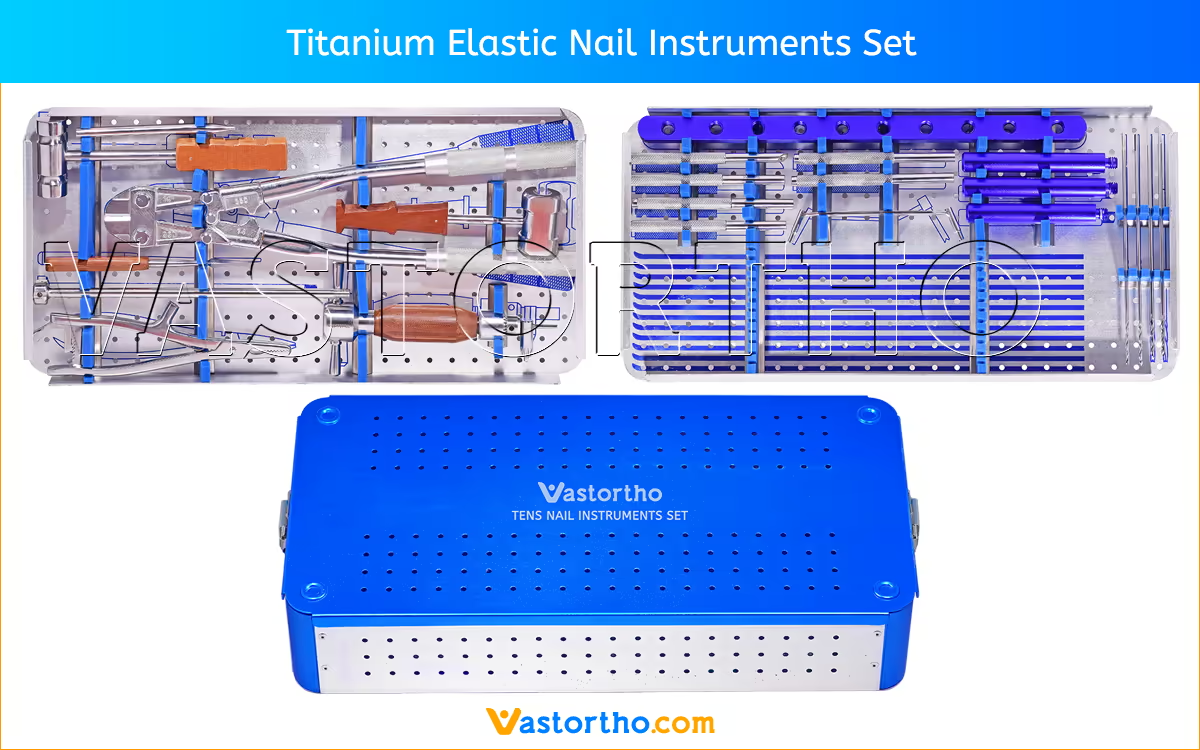
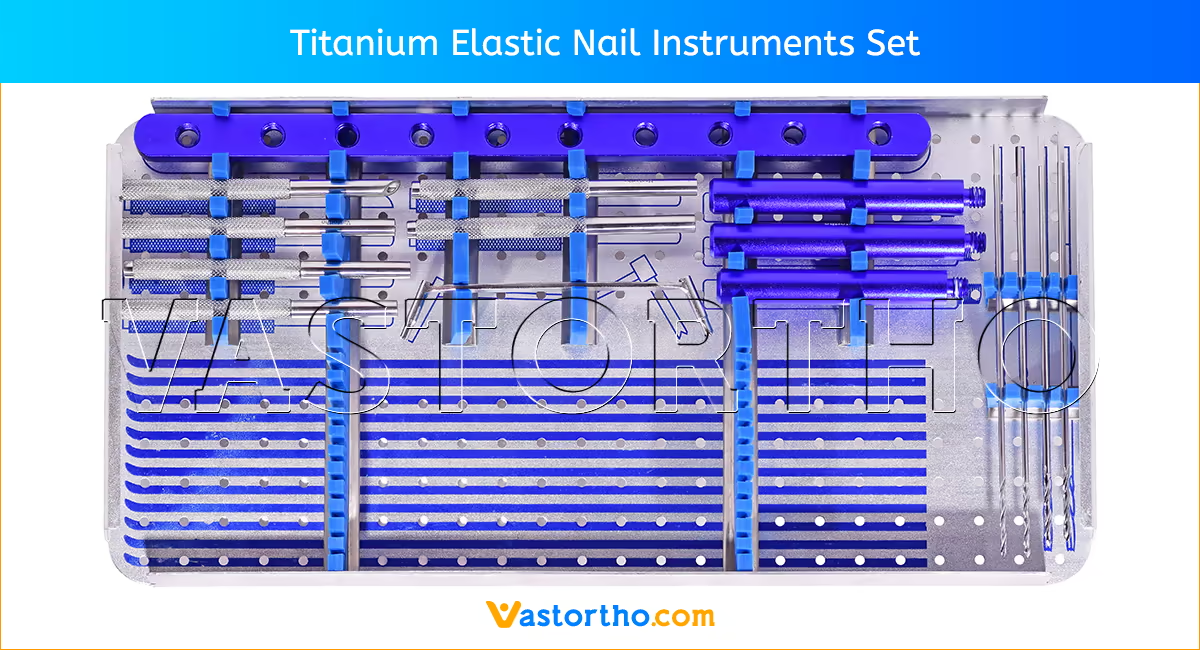
Complete Titanium Elastic Nail Instrument Set organized in a two-tier anodized sterilization case

Standard Set Configuration & Bill of Materials (Titanium Elastic Nail Instrument Set)

Below is the standard factory Bill of Materials for the Titanium Elastic Nail Instrument Set. Built-in titanium elastic nail implant caddies (Ø 1.5mm–5.0mm) and custom OEM private-label laser markings are available upon request.

  • F Tool Bar Small for Reduction
  • Threaded Rod for F Tool Bar
  • Threaded Rod for F Tool Bar
  • Threaded Rod for F Tool Bar
  • Elastic Nail Impactor Oblique 4.5 mm
  • Elastic Nail Impactor 2.0 mm
  • Elastic Nail Impactor 2.5 mm
  • Elastic Nail Impactor 3.0 mm
  • Elastic Nail Impactor 3.5 mm
  • Elastic Nail Impactor 4.0 mm
  • Double Drill Guide 3.2/4.5 mm
  • Drill Bit 3.2 x 200 mm
  • Drill Bit 3.2 x 200 mm
  • Drill Bit 3.5 x 200 mm
  • Drill Bit 3.5 x 200 mm
  • Extraction Plier for TENS Nail
  • Extractor Rod
  • Bone Awl
  • Hammer Fibre Handle 500 grams
  • Pin Wrench 4.5 x 120 mm
  • Slide Hammer
  • Nail Cutter 14 inches
  • TENS Nail Inserter, T Handle with Chuck and Key
  • Graphics Aluminium Box with Silicone Fittings
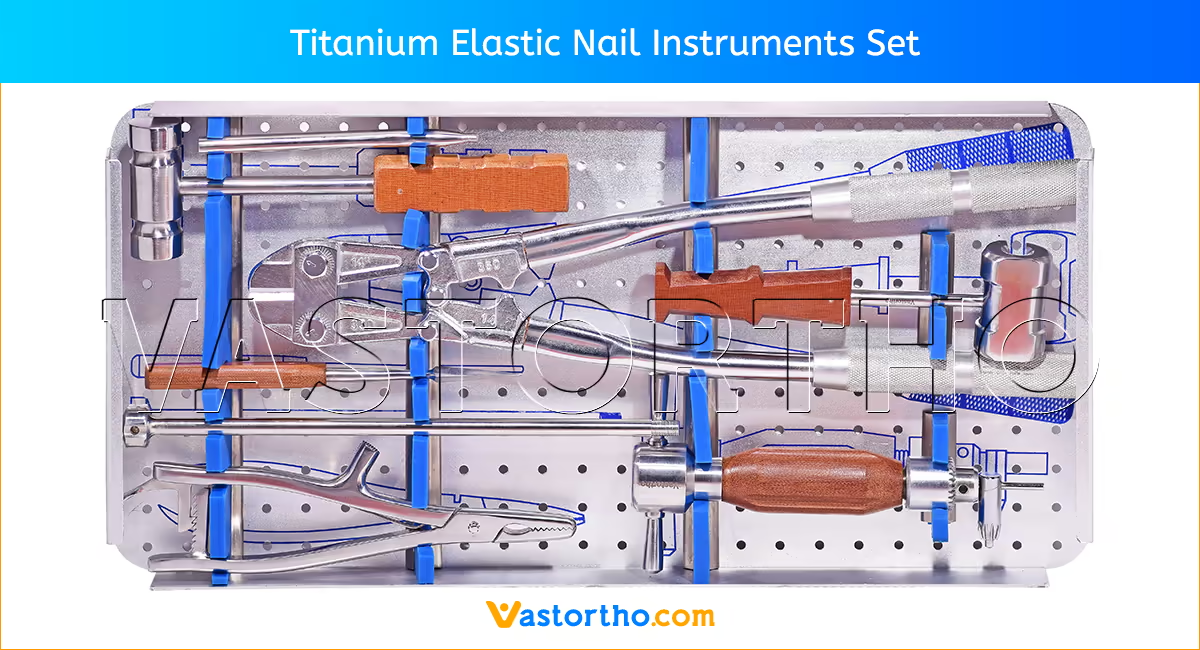
Universal collet inserter chuck, driving stop, and slotted hammer from the TENS Nail Instrument Set

Compound-action beveled nail cutter and pre-bending pliers in the Elastic Stable Intramedullary Nail (ESIN) Instrument System

Pediatric Diaphyseal Femur, Tibia, and Forearm Nailing Set produced by a certified Titanium Elastic Nail Instrument Set Manufacturer

Physeal-Sparing Three-Point Fixation: Unified TENS Nail Instrument Set & Elastic Stable Intramedullary Nail (ESIN) Instrument System

Pediatric and adolescent diaphyseal fractures require internal splinting that respects open epiphyseal growth plates (physes) while providing enough axial and rotational stability to eliminate bulky spica casting. By introducing two symmetrically pre-bent flexible nails through metaphyseal entry portals into the medullary canal, the Elastic Stable Intramedullary Nail (ESIN) Instrument System establishes six points of opposing cortical contact (three-point fixation per nail). This biomechanical construct converts shear and bending forces into controlled axial micromotion, stimulating rapid bridging periosteal callus formation.

Configured to serve simultaneously as a clinical Titanium Elastic Nail Instrument Set and a globally standardized TENS Nail Instrument Set, our instrumentation streamlines every phase of the procedure—from initial oblique cortical entry to elective hardware extraction after fracture consolidation.

Precision Biomechanical Engineering: Pediatric Flexible Intramedullary Nail Instrument Set Capabilities

Advancing flexible titanium nails across a narrow medullary isthmus and trimming the distal ends without soft-tissue irritation require specialized mechanical tools. Engineered as a high-precision Pediatric Flexible Intramedullary Nail Instrument Set, this platform incorporates five critical design advancements:

  • Pass-Through Cannulated Universal Inserter Chuck: The ergonomic T-handle Jacobs/collet inserter chuck accepts the full range of Ø 1.5mm to Ø 5.0mm nails through its central cannulation. A self-centering three-jaw collet and heavy-duty locking spanner grip the nail shaft securely without scoring the titanium surface or slipping under high rotational torque.
  • Controlled Slotted Impaction & Driving Stop Assembly: A quick-attach driving stop block locks onto the inserter chuck shaft, providing a solid anvil for the reversible slotted hammer. Surgeons can advance or retract the nail along the medullary canal with controlled axial blows while maintaining exact rotational control of the curved nail tip.
  • Standard & End-Cap Hollow Impactors: Includes both a standard cannulated impactor (leaving a precise 5mm–7mm extra-cortical nail tail for easy future removal) and a thin-wall end-cap impactor paired with a self-retaining end-cap screwdriver for seating threaded metallic end caps in unstable femoral or tibial fractures.
  • Extraction Pliers: Because pediatric elastic nails are routinely removed 6 to 12 months post-injury, the tray includes dedicated heavy-duty locking extraction pliers equipped with an integrated strike horn for slotted-hammer back-slapping.

Multi-Anatomical Indications: Turnkey Pediatric Diaphyseal Femur, Tibia, and Forearm Nailing Set

By housing cortical awls, multi-diameter drill sleeves, bending pliers, and extraction instruments inside one consolidated case, surgical facilities can manage the entire spectrum of pediatric trauma (typically ages 3 to 15 years) as well as select adult small-diameter diaphyseal fractures. Operating as an all-in-one Pediatric Diaphyseal Femur, Tibia, and Forearm Nailing Set, the system supports:

Lower & Upper Extremity Applications in Pediatric and Adolescent Trauma

Pediatric Diaphyseal Femoral Fractures (AO/OTA 32-D): Transverse, short oblique, and spiral mid-shaft femoral fractures stabilized via dual retrograde ascending nails inserted proximal to the distal femoral physis.

Pediatric Diaphyseal Tibial Fractures (AO/OTA 42-D): Unstable closed or Grade I/II open tibial shaft fractures stabilized via dual antegrade descending nails inserted distal to the proximal tibial physis and tibial tuberosity.

Pediatric Forearm (Radius & Ulna) Shaft Fractures (AO/OTA 22-D): Displaced both-bone forearm fractures stabilized via opposing single-nail fixation (retrograde radial styloid/Lister’s tubercle entry and antegrade olecranon/proximal ulnar entry) to preserve pronation and supination.

Pediatric Humeral Shaft & Subcapital Fractures (AO/OTA 12-D & 11-D): Stabilized via retrograde lateral supracondylar entry, avoiding radial nerve and rotator cuff morbidity.

Adult Clavicle & Fibular Shaft Fractures: Minimally invasive intramedullary splinting of displaced mid-shaft clavicular fractures and complex ankle fibular fractures.

Sterile Processing (SPD) Efficiency & Modular Graphic Case Architecture

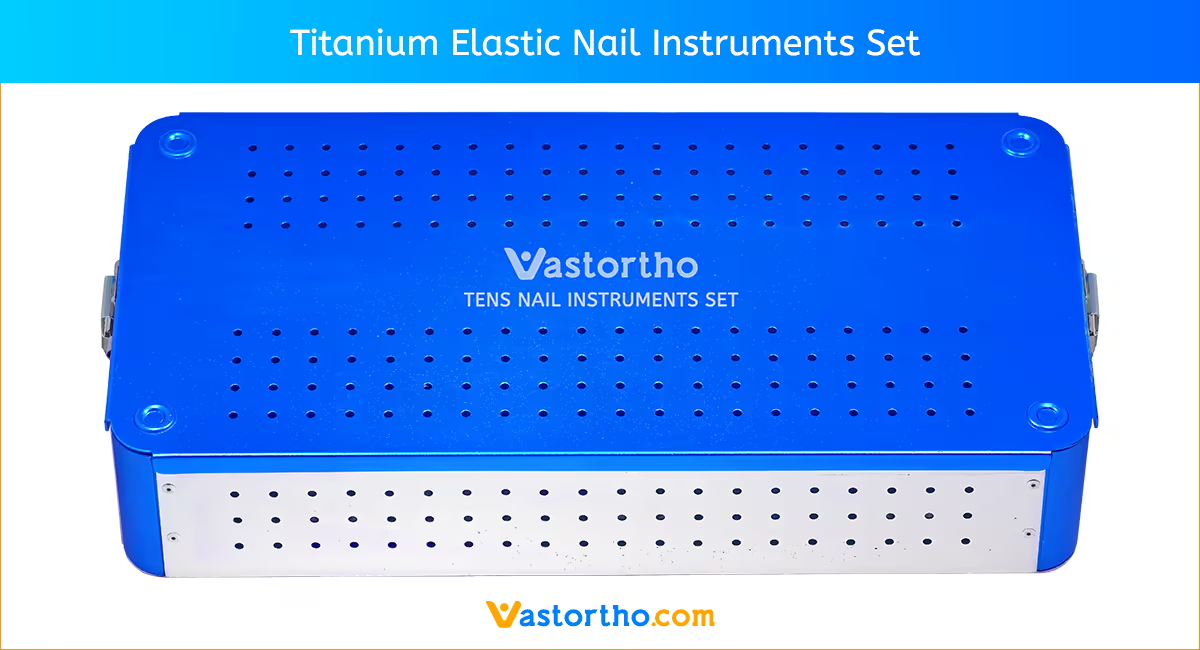
Hospital Sterile Processing Departments (SPD) and operating room managers evaluate pediatric trauma systems on autoclave reliability, ergonomic weight distribution, and rapid visual inventory counts. Our Titanium Elastic Nail Instrument Set is housed in a perforated, hard-anodized aluminum sterilization container with silicone holders.

  • High-Flow Steam Perforation Geometry: Engineered with an open-surface perforation ratio exceeding 45% to guarantee rapid steam penetration and moisture evacuation during standard pre-vacuum steam sterilization cycles (132°C / 270°F for 4 minutes).
  • Ergonomic Modular Split-Tray Design: Titanium Elastic Nail Instrument Set Tray engineered to comply with the weight limit per container by distributing heavy reduction forceps and drilling/tapping modules across balanced, stackable graphic tiers.

Direct OEM & Global Supply: Certified Titanium Elastic Nail Instrument Set Manufacturer

Sourcing pediatric intramedullary instrumentation directly from a dedicated Titanium Elastic Nail Instrument Set Manufacturer eliminates third-party distributor markups and guarantees reliable mechanical performance in the operating room. Because cutting work-hardened elastic nails requires extreme shear hardness, our beveled nail cutters and extraction jaws undergo specialized metallurgical treatment and testing prior to shipment.

  • Custom OEM & Implant-Matched Trays: As a full-service Titanium Elastic Nail Instrument Set Manufacturer, we can integrate a dedicated removable TENS implant tube rack (holding Ø 1.5mm to Ø 4.0mm nails and end caps) directly into the sterilization container to match your catalog SKU requirements.
  • Global Regulatory & Tender Compliance: Manufactured in an ISO 13485:2016 certified facility.

Frequently Asked Questions

Q1: What is the difference between a Titanium Elastic Nail Instrument Set, a TENS Nail Instrument Set, and an ESIN Set?

In clinical orthopedic terminology and global B2B procurement, Titanium Elastic Nail Instrument Set, TENS Nail Instrument Set (Titanium Elastic Nailing System), and Elastic Stable Intramedullary Nail (ESIN) Instrument System refer to the exact same surgical platform. Our unified system satisfies both Western pediatric hospital standards and international government tender specifications.

Q2: Does this Pediatric Diaphyseal Femur, Tibia, and Forearm Nailing Set include instruments for hardware removal?

Yes. Because pediatric elastic nails are routinely removed once the fracture heals, our Pediatric Diaphyseal Femur, Tibia, and Forearm Nailing Set includes a 6mm cortical bone gouge, narrow-nose forearm extraction forceps, and heavy-duty vice-grip locking extraction pliers that couple directly with the 500g slotted hammer for effortless nail removal.

Q3: What are the sterilization parameters for the Titanium Elastic Nail Instrument Set container?

The anodized aluminum sterilization container is validated for standard hospital pre-vacuum steam autoclave sterilization at (132°C / 270°F) for 4 minutes with a minimum 20–30 minute drying cycle, as well as 134°C (273°F) for 3 minutes under European/WHO sterilization protocols.

Q4: As a Titanium Elastic Nail Instrument Set Manufacturer, do you offer OEM private-label branding and built-in nail caddies?

Yes. As a direct Titanium Elastic Nail Instrument Set Manufacturer, we provide comprehensive OEM and private-label services for orthopedic implant companies and regional distributors, including custom laser-etched brand logos, bespoke anodized case colors, and integrated sterilization tube racks for storing Ø 1.5mm–5.0mm elastic nails inside the tray.

Do you have any questions for Titanium Elastic Nail Instrument Set?
Please fill this form we will get in touch with you shortly.
This field is for validation purposes and should be left unchanged.
Name(Required)

More Products from Orthopedic Instruments Set

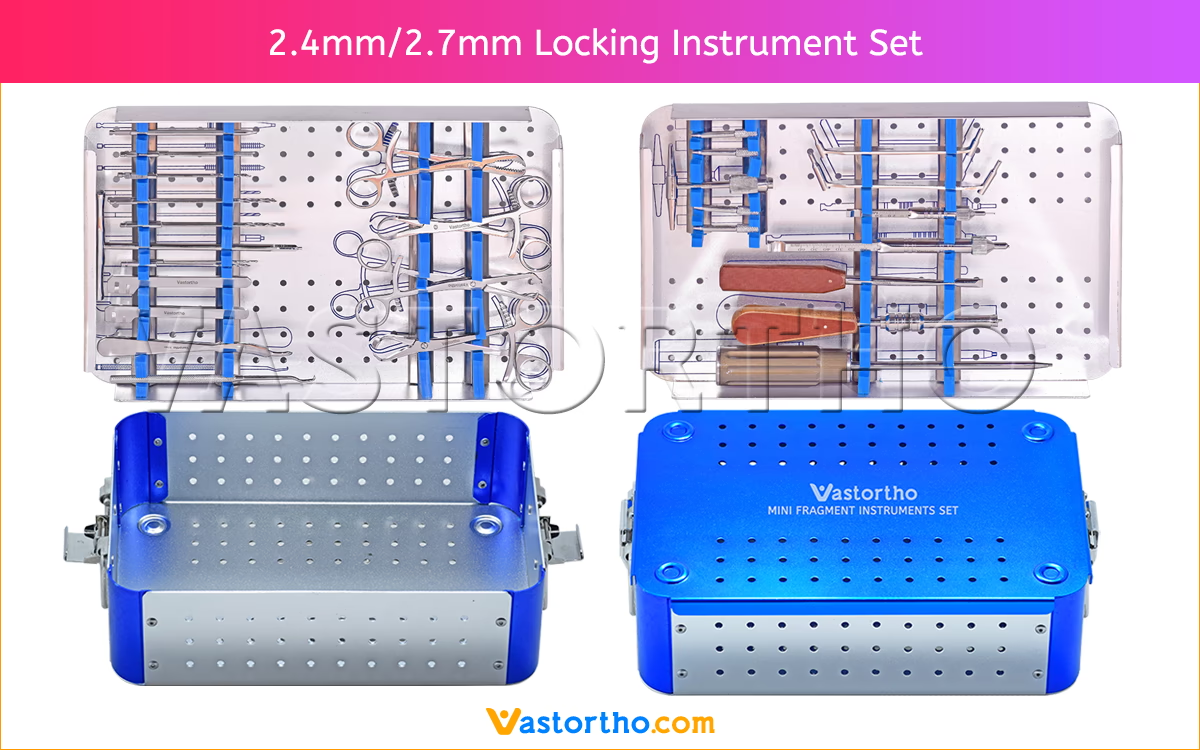
2.4mm/2.7mm Locking Instrument Set in anodized orthopedic small bone trauma instrument tray

2.4mm/2.7mm Locking Instrument Set

October 17, 2026/by VastOrtho
Anterior Cervical Plate Instruments Set

Anterior Cervical Plate Instrument Set

May 23, 2026/by VastOrtho
Spine Cervical Cage Instruments Set

Cervical Cage Instrument Set

May 12, 2026/by VastOrtho
Complete 3.5mm Small Fragment Locking Instrument Set in an anodized small fragment trauma instrument tray

3.5mm Small Fragment Locking Instrument Set

February 1, 2021/by VastOrtho
Complete 4.5mm/5mm Large Fragment Locking Instrument Set in an anodized large fragment trauma instrument tray

4.5mm/5mm Large Fragment Locking Instrument Set

January 30, 2021/by VastOrtho
Complete Dynamic Hip Screw Instrument Set in an anodized sterilization tray

Dynamic Hip Screw Instrument Set

January 27, 2021/by VastOrtho
Complete Tibial Nail Instrument Set organized in an anodized orthopedic tibial nail instrument tray

Tibial Nail Instrument Set

January 26, 2021/by VastOrtho
expert tibial nail instrument set hero

Expert Tibial Nail Instrument Set

January 25, 2021/by VastOrtho
Complete PFN Nail Instrument Set organized in a two-tier anodized sterilization case

PFN Nail Instrument Set

January 24, 2021/by VastOrtho
Complete PFNA Instrument Set and PFNA-II Instrument Set in an anodized sterilization tray

PFNA Instrument Set

January 22, 2021/by VastOrtho
Complete Gamma Nail Instrument Set organized in a two-tier anodized sterilization case

Gamma Nail Instrument Set

January 21, 2021/by VastOrtho
Complete Humeral Nail Instrument Set organized in a two-tier anodized sterilization case

Humeral Nail Instrument Set

January 20, 2021/by VastOrtho
Complete Titanium Elastic Nail Instrument Set organized in a two-tier anodized sterilization case

Titanium Elastic Nail Instrument Set

January 18, 2021/by VastOrtho
Kuntscher Nail Instruments Set

Kuntscher Nail (K Nail) Instruments Set

January 16, 2021/by VastOrtho
Complete Herbert Screw Instrument Set organized in a two-tier anodized sterilization case

Herbert Screw Instrument Set

January 13, 2021/by VastOrtho
Headless Screws Instruments Set

Headless Screws Instruments Set

January 13, 2021/by VastOrtho
4 mm Cannulated Cancellous Screws Instruments Set

4 mm Cannulated Screws Instruments Set

January 13, 2021/by VastOrtho
6.5 mm Cannulated Cancellous Screws Instruments Set

6.5mm Cannulated Screws Instruments Set

January 12, 2021/by VastOrtho
Spine Instruments Set

Spine Instruments Set

January 11, 2021/by VastOrtho
Pedicle Screws Instruments Set

Pedicle Screws Instruments Set

January 10, 2021/by VastOrtho
Laminectomy Instruments Set

Laminectomy instruments set

January 5, 2021/by VastOrtho
Bipolar Instruments Set

Bipolar Instruments Set

January 4, 2021/by VastOrtho
Angle Blade Plate Instruments Set

Angle Blade Plate Instruments Set

January 3, 2021/by VastOrtho
Austin Moore Instruments Set

Austin Moore Instruments Set

January 2, 2021/by VastOrtho
Broken Screw Removal Instruments Set

Broken Screw Removal Set

January 1, 2021/by VastOrtho
Complete Femoral Nail Instrument Set organized in a two-tier anodized sterilization tray

Femoral Nail Instrument Set

January 9, 2019/by VastOrtho
Polyaxial Screws Instruments Set

Polyaxial Screws Instruments Set

January 7, 2019/by VastOrtho

Surgical Techniques using Titanium Elastic Nail Instruments Set

TENS Nail (Titanium Elastic Nail) Uses

Femoral fractures in children are typically stabilized with two flexible intramedullary nails inserted in a retrograde manner from medial and lateral entry points above the distal physis. Antegrade nailing, with a lateral entry point, is normally reserved for very distal femoral fractures. Every stage of this procedure—from cortical entry and closed reduction to flush trimming and extraction—is executed using our Titanium Elastic Nail Instrument Set (also configured globally as a complete TENS Nail Instrument Set). Engineered by an ISO-certified Titanium Elastic Nail Instrument Set Manufacturer, each instrument is arranged in sequential surgical order to streamline operating room workflows.

Positioning the Patient

Position the patient supine in a free position or on a fracture table with a traction boot. If fracture reduction can be accomplished with manual reduction (usually only in small patients), a standard table may be used. Position the image intensifier on the lateral side of the affected femur for AP and lateral views of the leg from knee to hip. The setup must allow the surgeon access to both the lateral and medial aspects of the distal femur. Reduce the fracture and confirm alignment with fluoroscopy in both the AP and lateral views. Prep and drape the leg from hip to knee for reduction and intraoperative imaging.

Contouring the Nails

Contour both elastic nails into a bow shape with the nail tip pointing to the concave side of the bowed implant. The etched line on the nail provides a reference for the nail tip during insertion and should follow the same plane as the bow. Contouring may be done by hand or with the bending instruments provided in the Titanium Elastic Nail Instrument Set. The apex of the bow should be at the level of the fracture. This shape allows the implant to generate optimal resistance to malaligning forces. The bow in each nail should be symmetrical for a balanced biomechanical effect.

Creating the Cortical Entry Point

Using the drill bit and guide sleeve from the TENS Nail Instrument Set, penetrate the near cortex. With the drill bit rotating, but not advancing, slowly lower the drill to a 45° angle relative to the shaft axis. Now advance the drill bit at this angle until it reaches the medullary canal.

Alternatively, the Curved Awl can be used to penetrate the near cortex. Vertically insert the Awl down to the bone. With a rotating motion, lower the Awl to a 45° angle relative to the shaft axis and continue to penetrate the cortical bone at an upward angle.

Inserting the Nail

Locate and maintain the entry hole with a fingertip while withdrawing the drill bit and introducing the implant. Using fluoroscopy, align the nail tip so the convex side will glance off the far cortex. Advance the nail through the drilled entry hole by hand as far as possible.

Select the Inserter with Universal Chuck from the Titanium Elastic Nail Instrument Set and attach it onto the nail with a length of about 150 mm of nail between the inserter and entry point. The longer this distance, the more difficult hammering will be since the flexible shaft will dampen the impact force. Tighten the inserter securely using the Spanner Wrench.

Attach the Slide Hammer to the shaft of the inserter. Use controlled blows to drive the nail up the medullary canal.

Alternatively, the Hammer Guide and Inserter can be used for nail insertion in the same manner described for the Inserter with Universal Chuck.

Monitor nail advancement with fluoroscopy. Ensure that the convex side of the nail tip is glancing off the far cortex and is advancing with each blow. The nail will bend as it progresses up the canal. This part of the procedure requires the greatest insertion force.

Reducing the Fracture

Use the Small F-Tool included in the TENS Nail Instrument Set to provide reduction forces on either side of the fracture gap. To assemble the tool:

  1. Thread one Threaded Rod at the end of the Bar.
  2. Thread the second rod into the bar so the rods just fit across the leg.
  3. Thread the third rod into the opposite end of the bar.

The Small F-Tool is placed on the leg at the level of the fracture so that both rods provide force on the opposing fragments to aid reduction.
Drive the first nail to the level of the fracture. In a similar manner to that previously described, open the femur on the opposite side and insert the second nail up to the level of the fracture.

Crossing the Fracture

Visualize the fracture with fluoroscopy and determine which nail will be easier to pass across the fracture line. Advance the nail that will most effectively pull the proximal fragment into alignment. Using the Inserter with Universal Chuck and Detachable Slide Hammer from the Titanium Elastic Nail Instrument Set, drive the nail across the fracture while monitoring its position with fluoroscopy. Alternatively, the Hammer Guide and Inserter may be used with the Detachable Slide Hammer to drive the nail.

The nail can be rotated to manipulate the curved tip across the fracture. Rotation is easiest while the implant is being advanced or retracted.

Care should be taken not to twist the nails more than 90°. Otherwise, a “corkscrew phenomenon” may be created and stability will be lost. Rotating the nail while it is stationary may loosen the Inserter.

Advance the first nail into the proximal fragment only enough to ensure reduction will be maintained. Further advancement may cause displacement of the proximal fragment, making it more difficult to pass the second nail. Confirm nail position in both the AP and lateral views.

Using the Inserter and Slide Hammer, drive the second nail across the fracture and into the proximal fragment. Continue advancing this nail until it is just distal to the proximal physis. Advance the other nail to the same level. The two nails should diverge in opposite directions, both medial and lateral, for optimal rotational stability. If the fracture is distracted, release traction and impact the patient’s heel.

Cutting the TENS Nail (Titanium Elastic Nail) to Length

Prior to cutting the implants to length, verify the position of both nails in relation to the rotation of the leg. Once the nail is inserted to its final position, mark the shaft with a pen or clamp at the planned cutoff point (the cutoff point should be 10–20 mm outside of the cortex). Retract the nail far enough to access the cutoff point from outside the incision (usually 25–50 mm).

Bend the nail end away from the bone to deform it slightly (approximately 10–15° of permanent deflection). This allows the protruding nail end to sit slightly off the cortex for easy future removal while remaining low-profile to minimize soft tissue irritation.

Cut the nail to the appropriate length using the Rod Cutter from the TENS Nail Instrument Set. Reinsert the nail with either the Standard Tamp or Beveled Tamp and Hammer. The Standard Tamp captures 2 mm of nail tip.

The Beveled Tamp captures 6 mm of nail tip and leaves approximately 10 mm of nail protruding from the cortex when the tamp is driven flush to the periosteum. Keep the etched line aligned with the long axis of the bone to keep the beveled surface in proper orientation. In order to prevent distraction of the fracture, a slight blow on the knee is recommended.

Confirm final implant position and fracture reduction with fluoroscopy. In its final position, the end of the nail should protrude 10–20 mm outside the cortex at an angle approximately 10–15° above the bone. If the nail has been overinserted, use the Locking Pliers to grip and retract the nail.

Nail Removal

Palpate over the distal nail end, make an incision in the skin, and bluntly dissect to expose the tip. Fluoroscopy may be needed to locate the nail end. Once exposed, attach the Locking Pliers included in the Titanium Elastic Nail Instrument Set. The pliers require only a few millimeters of engagement with the nail for removal in most cases.

If capturing the nail tip is difficult, the lower jaw of the Locking Pliers can be driven under the nail end with light mallet blows. Use care to protect the physis from damage.

To remove the implant, use the Hammer to strike the Locking Pliers on its “horn.” Once the nail is retracted a few millimeters, removal can usually be completed by hand. If the nail is still difficult to remove, the Inserter and Slide Hammer—precision-engineered by our Titanium Elastic Nail Instrument Set Manufacturer team—can be used to complete the extraction.

Partner Directly with a Certified Titanium Elastic Nail Instrument Set Manufacturer

Request a formal quotation or inquire about OEM private-label production for our Titanium Elastic Nail Instrument Set (TENS Nail Instrument Set).

PRODUCTS

CATALOGUE

COMPANY

Vast Ortho Footer Logo white

Orthopedic implants and surgical instruments. Twenty years of manufacturing experience, serving professional buyers in international markets.

© Vast Ortho:
Orthopedic Implants & Surgical Instruments Manufacturer
First Floor, Khasra No. 104/14 | B-Block, Sant Nagar, Burari | Delhi-110084, INDIA