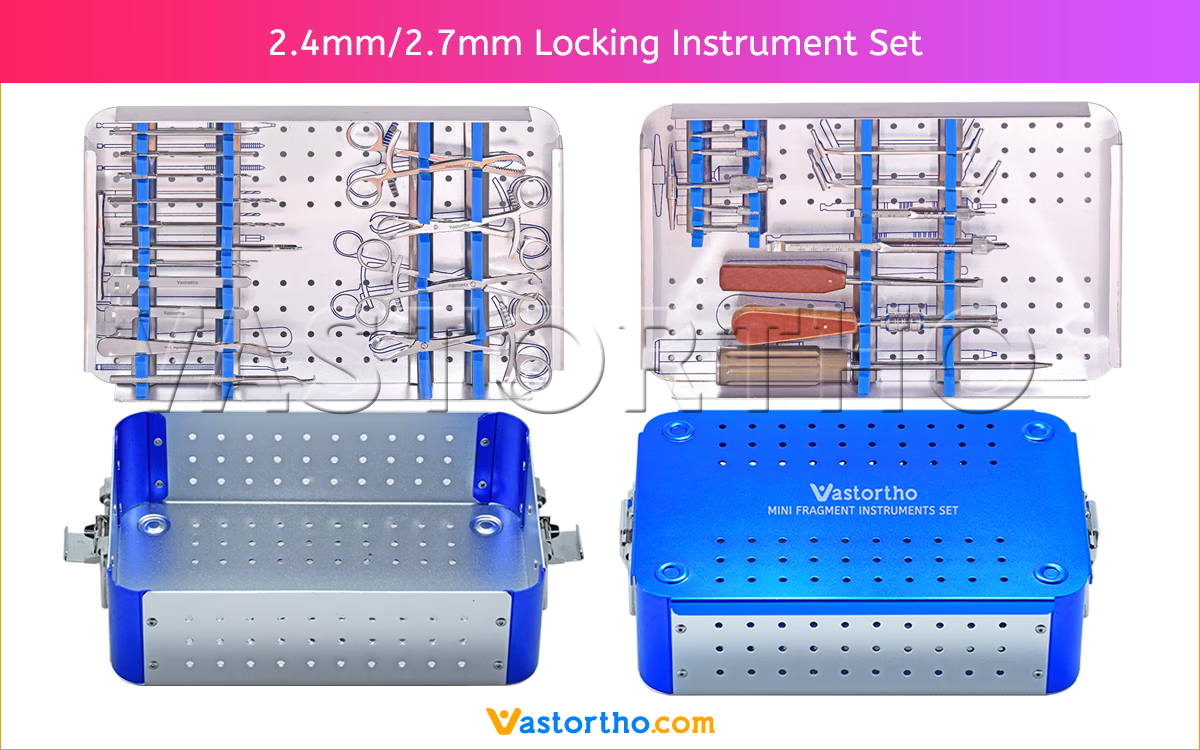
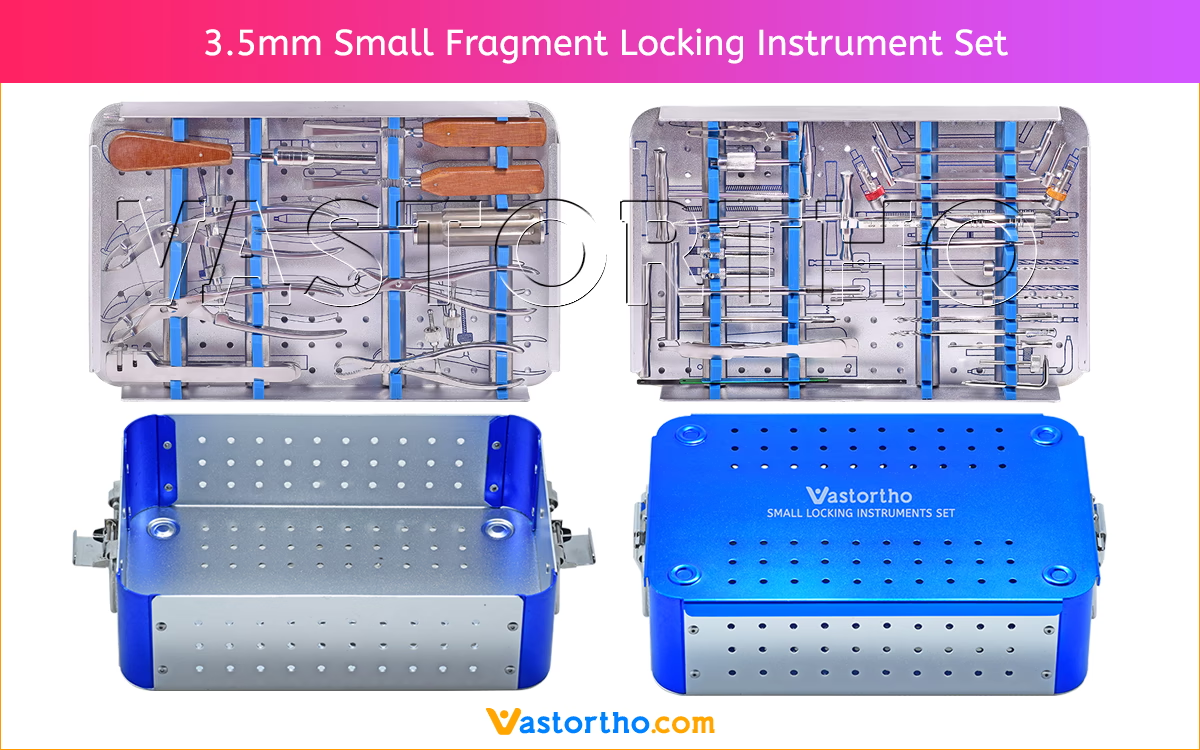
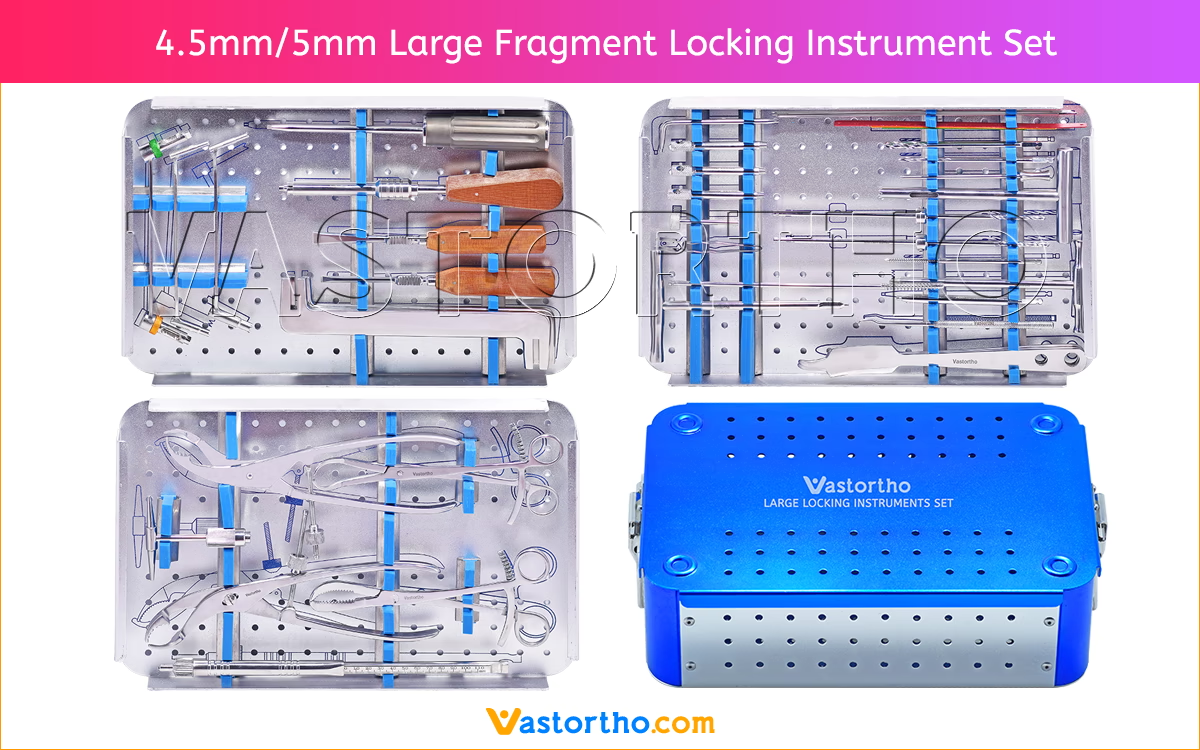
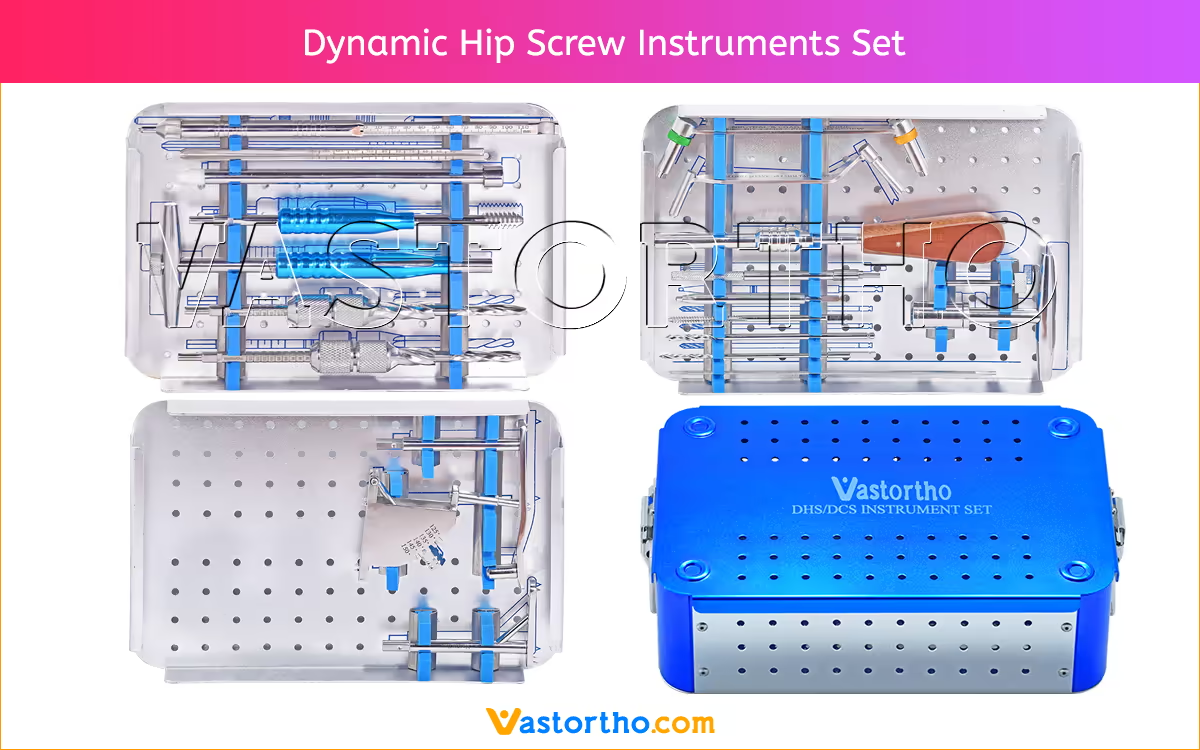
PFNA Instrument Set – Complete PFNA-II & Proximal Femoral Nail Antirotation Instrument System
Precision-Engineered Helical Blade Compaction, Radiolucent Cephalomedullary Targeting, and Lateral Cortex Protection Instrumentation for Geriatric & High-Energy Hip Osteosynthesis.
Designed for hospital trauma centers, geriatric hip fracture units, and global orthopedic distributors, our PFNA Instrument Set delivers single-column anti-rotation stability and streamlined fluoroscopic workflow for unstable proximal femoral fractures. Engineered directly by an ISO 13485-certified PFNA Instrument Set Manufacturer, this unified Proximal Femoral Nail Antirotation Instrument System consolidates minimally invasive trochanteric entry, cancellous bone-compacting helical blade insertion, and static/dynamic distal interlocking into one color-coded sterile platform. Whether your surgical team specifies a standard PFNA Instrument Set or an Asian-geometry PFNA-II Instrument Set (PFNA2), this single system provides universal implant compatibility.
- Cancellous Bone Compaction (Zero Bone Removal): Configured as a specialized Helical Blade Cephalomedullary Nail Instrument Set, guiding a single spiral/helical blade that radially compacts osteoporotic cancellous bone around the blade flutes rather than reaming it away—maximizing purchase in the femoral head.
- Universal PFNA & PFNA-II (PFNA2) Compatibility: Fully compatible with both original PFNA nails and second-generation flattened-lateral-wall PFNA-II nails across short (180mm–240mm) and long (300mm–420mm) lengths.
- Geriatric & Osteoporotic Hip Trauma Focus: Purpose-built as a turnkey Osteoporotic Intertrochanteric Hip Fracture Nailing Set, dramatically reducing cut-out and rotational malalignment in low-density bone.
- Certified Surgical Metallurgy: Manufactured under ISO 13485:2016 certified quality management systems using stainless steel with medical silicone ergonomics.
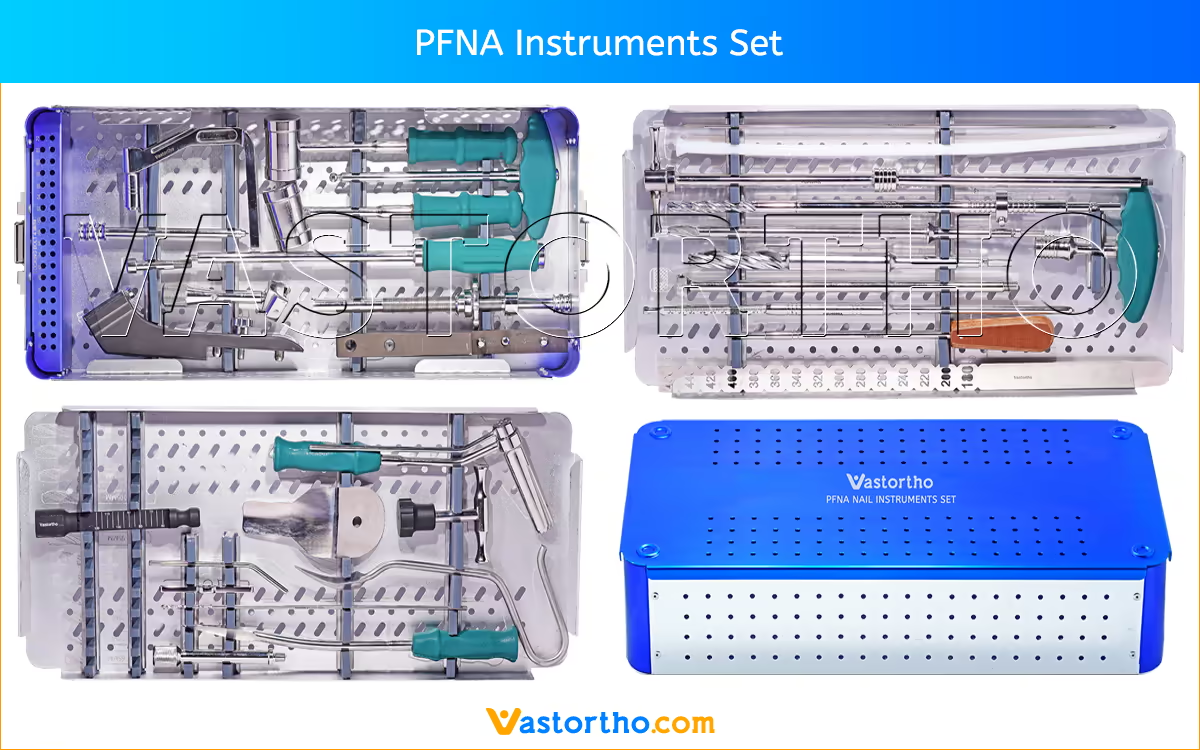
Standard Set Configuration – PFNA / PFNA-II Instrument Set
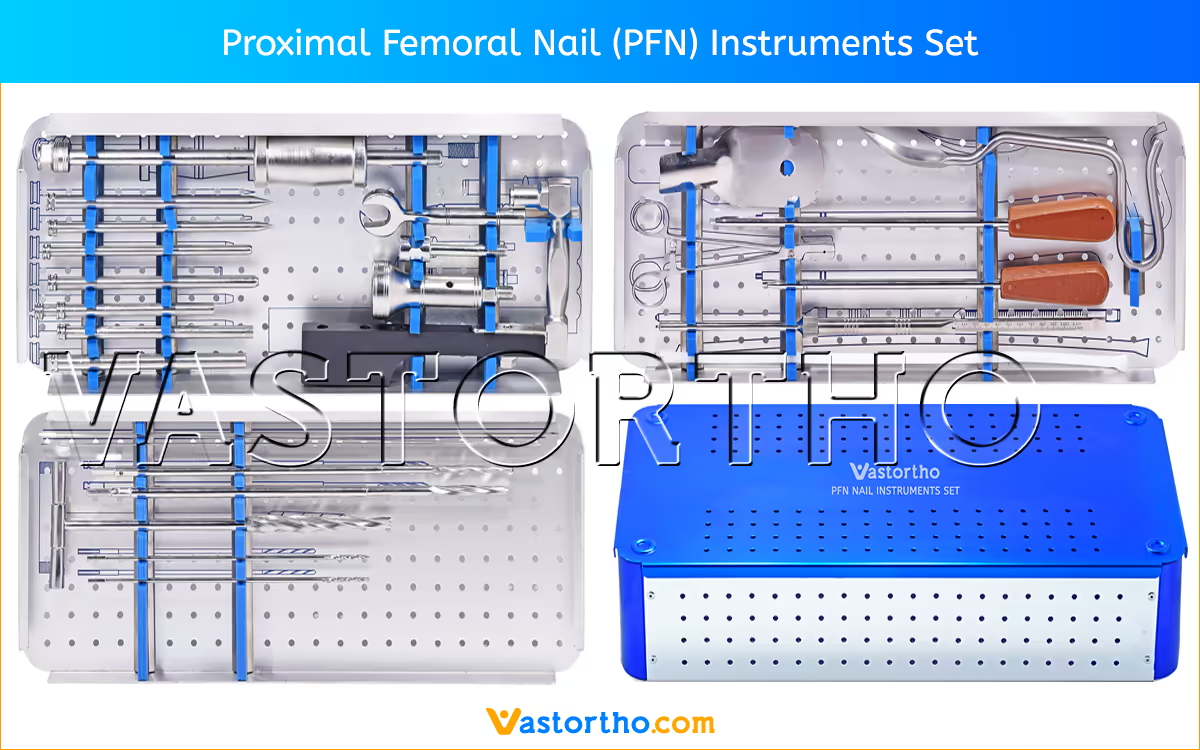
Below is the standard factory configuration for the combined PFNA Instrument Set and PFNA-II Instrument Set. Custom tray configurations, flexible medullary reamer sets, and OEM private-label laser marking are available upon request.
- PFNA Distal Zig : 1 Qty
- PFNA Proximal Zig : 1 Qty
- PFNA Zig Handle : 1 Qty
- Solid Hammer : 1 Qty
- Conical Bolt (Nail Holding Bolt) Tightner : 1 Qty
- Slotted Hammer : 1 Qty
- PFNA Blade Introducer : 1 Qty
- Driving Head : 1 Qty
- Conical Bolt (Nail Holding Bolt) : 1 Qty
- Proximal Sleeve Threaded With Nut : 1 Qty
- Wire Sleeve : 1 Qty
- Trocar 3 mm : 1 Qty
- Protection Sleeve : 1 Qty
- Drill Sleeve : 1 Qty
- Trocar : 1 Qty
- Guide Wire 3 mm : 1 Qty
- Medulary Tube : 1 Qty
- PFNA Blade Extractor : 1 Qty
- PFNA Blade Reamer : 1 Qty
- Cortex Reamer : 1 Qty
- Proximal Reamer 15 mm : 1 Qty
- Ram Rod : 1 Qty
- Depth Gauge : 1 Qty
- Screw Driver for 4.9 mm Locking Bolt : 1 Qty
- Measuring Scale : 1 Qty
- Quick Coupling Handle : 1 Qty
- Solapur Sleeve : 1 Qty
- Wire Sleeve for Solapur Sleeve : 1 Qty
- Tissue Protector : 1 Qty
- Wire Introducer : 1 Qty
- Measuring Gauge : 1 Qty
- Bending Rod 5 mm : 1 Qty
- PFNA Blade Key : 1 Qty
- Bone Awl : 1 Qty
- Drill Bit 4 mm x 300 mm : 1 Qty
- Bone Awl Cannulated : 1 Qty
- Nail Extractor : 1 Qty
- Graphics Aluminum Box with Silicone Fittings : 1 Qty
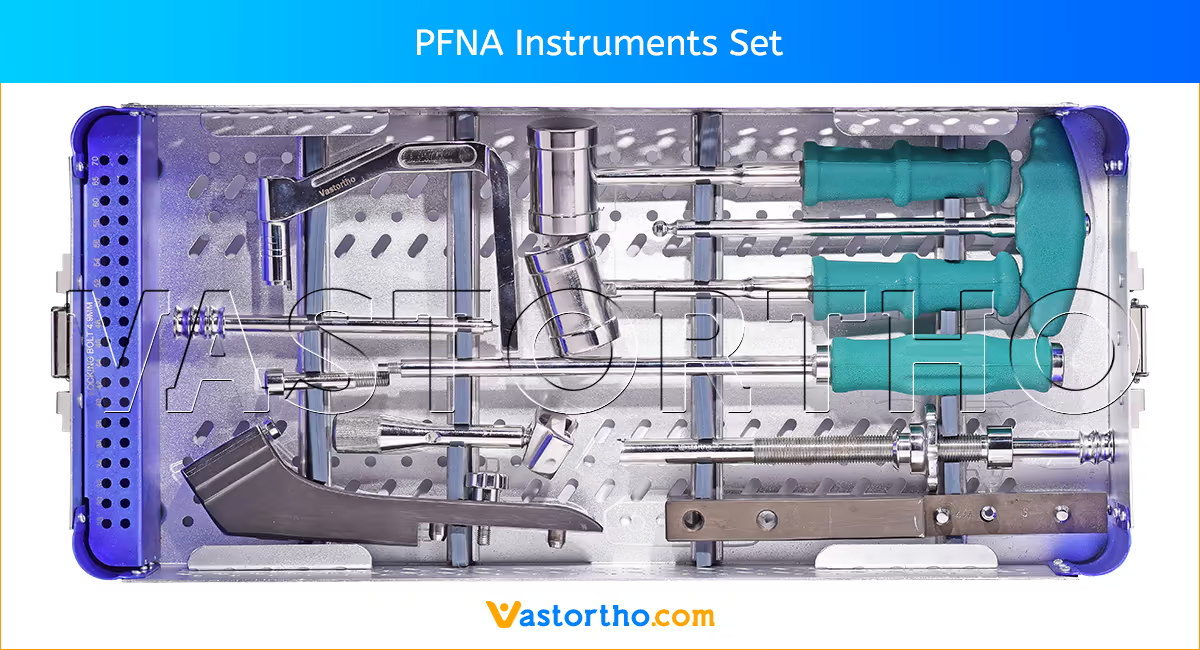
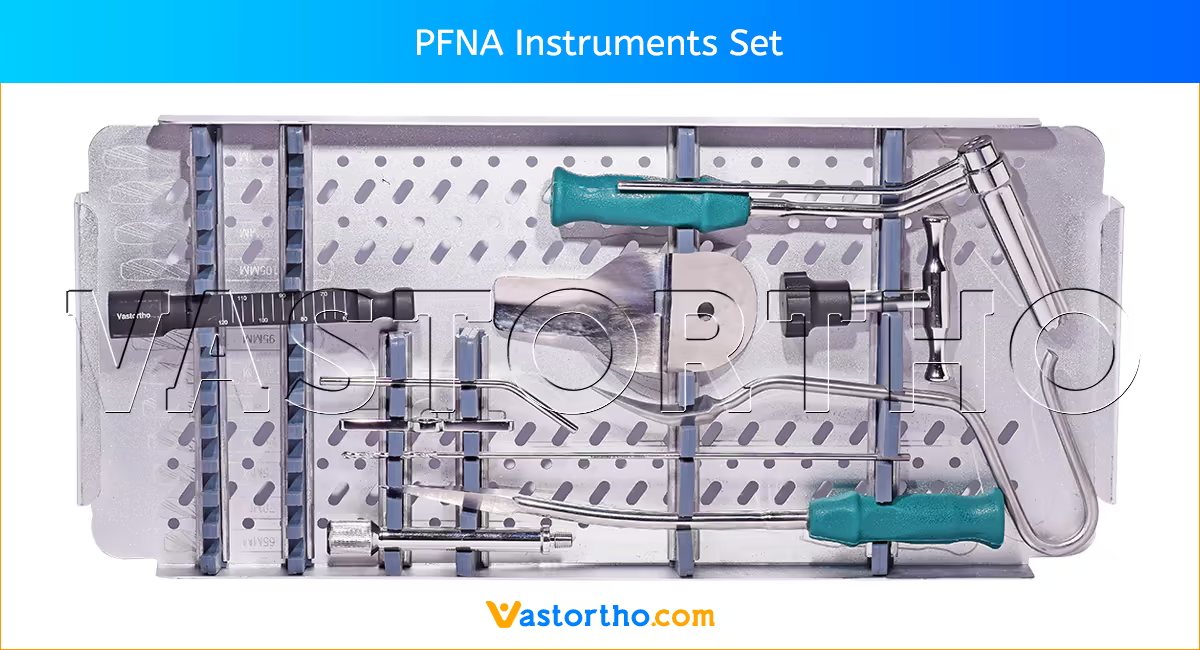
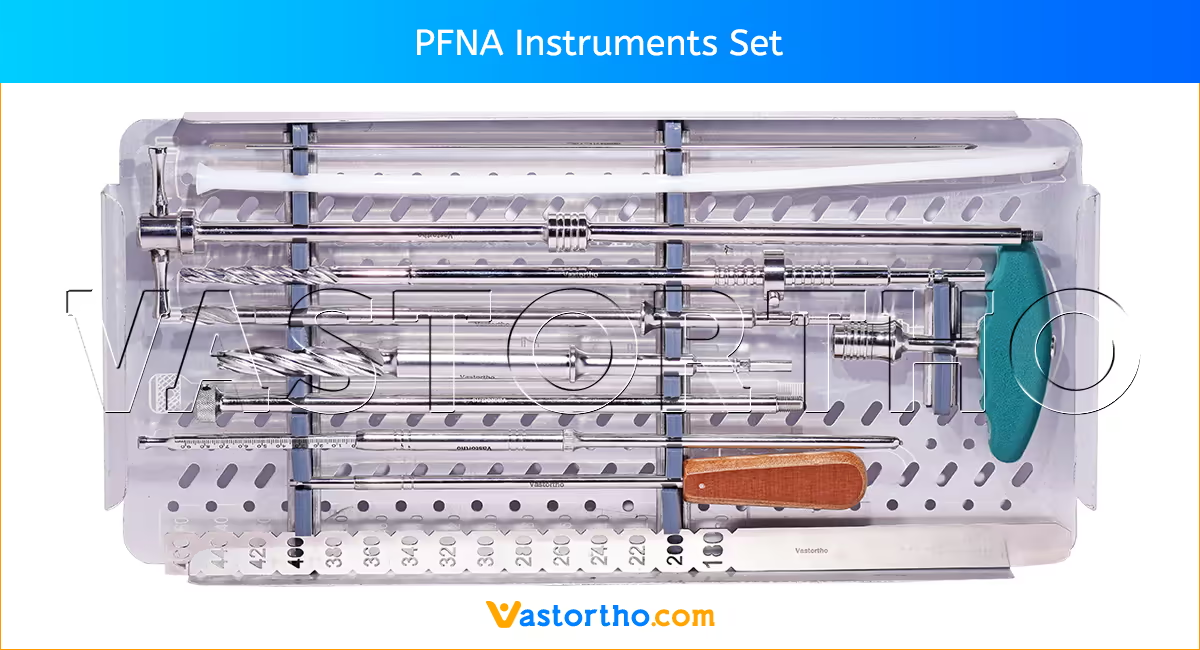
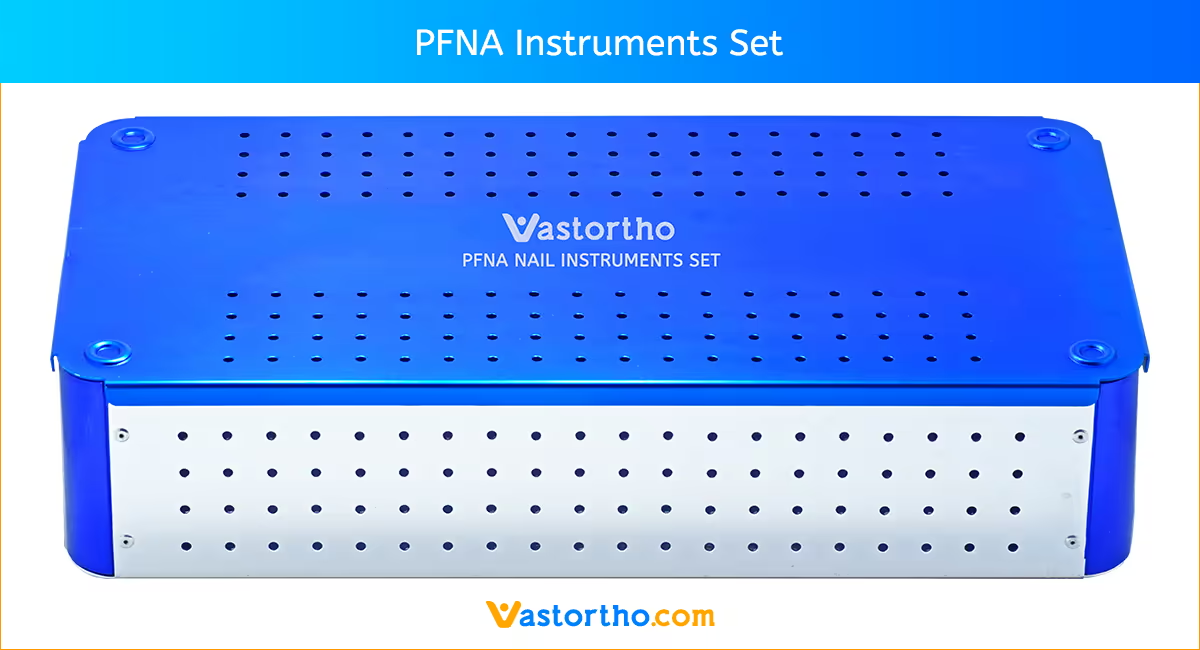
Universal PFNA-II Instrument Set & Proximal Femoral Nail Antirotation Instrument System Architecture
Conventional two-screw cephalomedullary nails require drilling two separate parallel channels in narrow femoral necks and remain vulnerable to uneven load distribution (“Z-effect” screw migration). Our Proximal Femoral Nail Antirotation Instrument System overcomes this challenge by consolidating rotational stability and axial load-bearing into a single, wide-surface helical blade.
Engineered to serve simultaneously as a standard PFNA Instrument Set and a second-generation PFNA-II Instrument Set, the instrumentation accommodates the anatomical refinements of modern Asian and Western proximal femoral nails. The stepped Ø 16.5mm / Ø 17.0mm proximal entry reamer and lateral-relief protection sleeve prevent lateral trochanteric wall impingement and hoop-stress cortical splitting during nail insertion—making the tray equally effective in smaller-stature patients and large femoral canals.
Biomechanical Compaction Engineering: Helical Blade Cephalomedullary Nail Instrument Set
In severely osteoporotic femoral heads, conventional triple reamers or large lag-screw drills remove vital trabecular bone stock. Configured as a high-precision Helical Blade Cephalomedullary Nail Instrument Set, this platform preserves native bone density through a controlled, step-by-step impaction and internal locking workflow:
- Three-Part Coaxial Protection &Buttress Nut Assembly: The outer protection sleeve, inner drill sleeve, and Ø 3.2mm guide-wire sleeve lock into the radiolucent aiming bow via a threaded lateral buttress nut, ensuring zero trajectory deflection against the lateral femoral cortex.
- Lateral Cortex-Only Opening Drill (Ø 11.0mm): Rather than reaming the entire femoral neck in osteoporotic patients, the calibrated Ø 11.0mm cannulated opening drill is engineered with a mechanical stop to open only the lateral femoral cortex, allowing the helical blade to compact cancellous bone along the remaining neck tract (a full-neck stepped reamer is also included for young patients with dense bone).
- Rotational Lock / Unlock Helical Blade Inserter: The cannulated blade impactor couples to the helical blade in an “unlocked” state so the spiral flutes rotate freely along their helical path during gentle slotted-hammer impaction. Once seated at the exact millimeter depth, rotating the inserter handle clockwise expands the internal locking core of the blade—preventing further rotation and locking the femoral head fragment.
- Controlled Interfragmentary Neck Compression: The buttress nut on the protection sleeve allows the surgeon to apply up to 5mm–7mm of controlled axial interfragmentary compression across the intertrochanteric fracture line without backing the nail out of the canal.
- Jig-Guided Short Nail & Freehand Long Nail Distal Locking: Features color-coded distal aiming ports on the targeting arm for static or dynamic Ø 4.9mm locking of short nails, plus a freehand targeting wand for distal locking of long PFNA/PFNA-II nails.
Clinical Indications: Turnkey Osteoporotic Intertrochanteric Hip Fracture Nailing Set
Fragility hip fractures in elderly patients require rapid, minimally invasive stabilization that permits immediate full weight-bearing without risk of superior femoral head cut-out. Engineered specifically as an Osteoporotic Intertrochanteric Hip Fracture Nailing Set, this platform covers the full spectrum of unstable proximal femoral trauma.
Pertrochanteric, Reverse Oblique & Subtrochanteric Applications (AO/OTA 31-A1, 31-A2, 31-A3 & 32)
- Osteoporotic Pertrochanteric & Intertrochanteric Fractures (AO/OTA 31-A1 & 31-A2): Multi-fragmentary geriatric hip fractures where helical blade cancellous compaction provides superior pull-out and cut-out resistance compared to threaded lag screws.
- Reverse Oblique & Lateral Wall-Compromised Fractures (AO/OTA 31-A3): Unstable transtrochanteric fractures where the intramedullary nail shaft acts as an internal lateral buttress to prevent femoral shaft medialization.
- High & Low Subtrochanteric Fractures: Managed using the long-nail configuration of our Osteoporotic Intertrochanteric Hip Fracture Nailing Set, combining proximal helical blade fixation with distal bi-planar shaft locking.
- Ipsilateral Femoral Neck/Shaft & Pathological Fractures: Segmental high-energy trauma and prophylactic stabilization of osteolytic metastatic lesions in the proximal femur.
Sterile Processing (SPD) Efficiency & Modular Graphic Case Architecture
Hospital Sterile Processing Departments (SPD) and operating room managers evaluate surgical systems on sterilization throughput, weight compliance, and visual inventory verification. Our PFNA Instrument Set is housed in a perforated, hard-anodized aluminum sterilization case with non-degrading medical silicone brackets.
- High-Flow Perforation Geometry: Engineered with open-surface perforation ratio to guarantee rapid steam penetration and moisture evacuation during standard pre-vacuum steam sterilization cycles (132°C / 270°F for 4 minutes).
Ergonomic Modular Split-Tray Design: PFNA Instrument Set Tray engineered to comply with the 25 lb (11.3 kg) AAMI ST77 weight limit per container by distributing heavy reduction forceps and drilling/tapping modules across balanced, stackable graphic tiers.
Direct OEM & Global Supply: Certified PFNA Instrument Set Manufacturer
Sourcing helical blade targeting systems directly from a dedicated PFNA Instrument Set Manufacturer eliminates third-party distributor markups and guarantees micron-level coaxial alignment between your aiming jigs and PFNA/PFNA-II implants. Every aiming bow, buttress sleeve, and blade impactor is inspected on measuring machines and test-fitted against master implant gauges prior to shipment.
- Surgical Cutting & Drilling Metallurgy: Stepped reamers, awls, taps, and calibrated twist drill bits are machined from stainless steel, vacuum heat-treated to 48–52 HRC for enduring flute sharpness.
- Custom OEM Jig-to-Implant Calibration: As a full-service PFNA Nail Instrument Set Manufacturer, we calibrate proximal aiming blocks to match standard AO PFNA geometry or your proprietary short/long nail blueprint.
- Global Regulatory & Tender Compliance: Manufactured in an ISO 13485:2016 certified facility.
Frequently Asked Questions
Q1: Is this PFNA Instrument Set compatible with both standard PFNA and Asian PFNA-II (PFNA2) nails?
Yes. Our unified Proximal Femoral Nail Antirotation Instrument System functions as both a standard PFNA Instrument Set and a PFNA-II Instrument Set. It supports 6° mediolateral bend geometries, Ø 16.5mm proximal diameters, and 130° neck-shaft angles across short and long nails.
Q2: How does the Helical Blade Cephalomedullary Nail Instrument Set prevent blade cut-out in osteoporotic bone?
Unlike standard lag screws that remove bone during reaming, our Helical Blade Cephalomedullary Nail Instrument Set uses an Ø 11.0mm drill to open only the lateral femoral cortex. As the helical blade is impacted along the Ø 3.2mm guide wire, its spiral flutes radially compact native cancellous bone around the blade tip—creating a dense bone halo that resists varus collapse and rotational cut-out.
Q3: How does the lock/unlock mechanism on the helical blade inserter work?
During insertion, the impactor threads onto the blade in an unlocked state so the spiral flutes can rotate smoothly along their helical pitch. Once the blade reaches the desired subchondral depth, turning the inserter handle clockwise advances an internal locking core inside the blade, locking its rotation and stabilizing the femoral head fragment.
Q4: What are the sterilization parameters for the PFNA / PFNA-II sterilization tray?
The anodized aluminum sterilization container is validated for standard hospital pre-vacuum steam autoclave sterilization at (132°C / 270°F) for 4 minutes with a minimum 20–30 minute drying cycle, as well as 134°C (273°F) for 3 minutes under European/WHO sterilization protocols.
Q5: As a PFNA Instrument Set Manufacturer, do you offer OEM private-label branding and custom jig calibration?
Yes. As a direct PFNA Instrument Set Manufacturer, we provide comprehensive OEM and private-label manufacturing for orthopedic implant companies and regional distributors. We can customize laser-etched brand logos, anodized tray colors, silicone bracket layouts, and proximal aiming jigs calibrated to your exact helical blade and nail blueprint.
Do you have any questions for PFNA Instruments Set?
Please fill this form we will get in touch with you shortly.