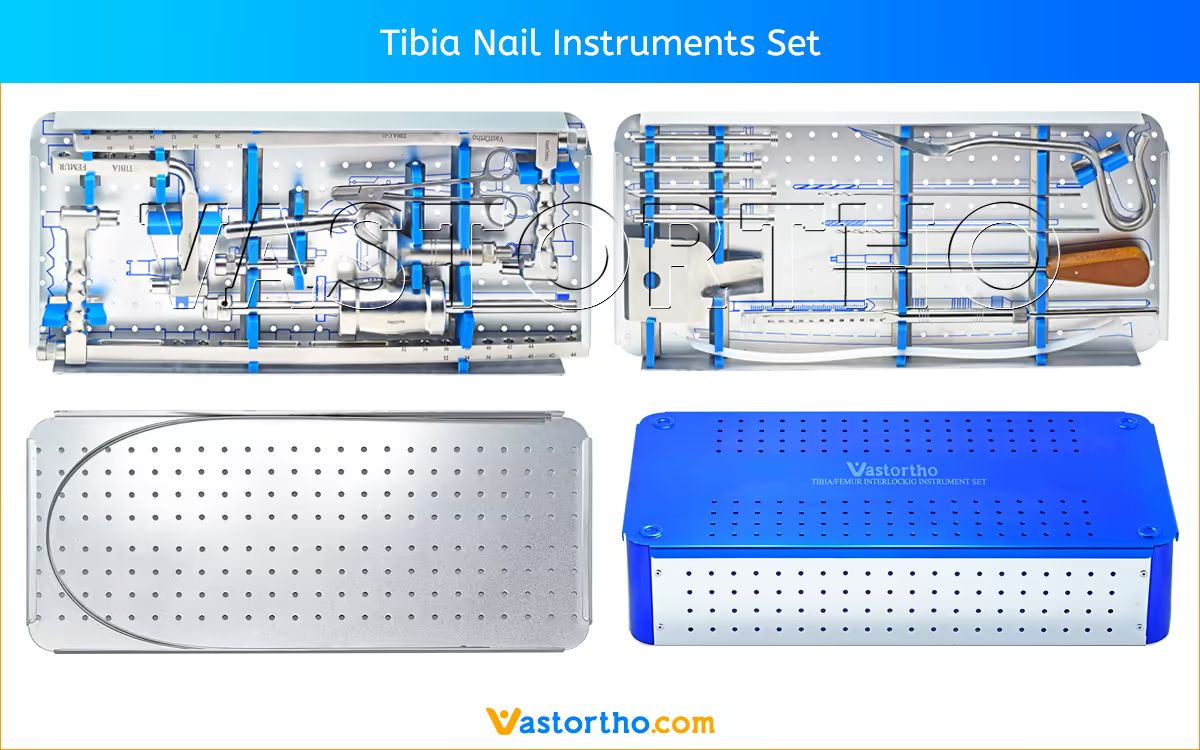
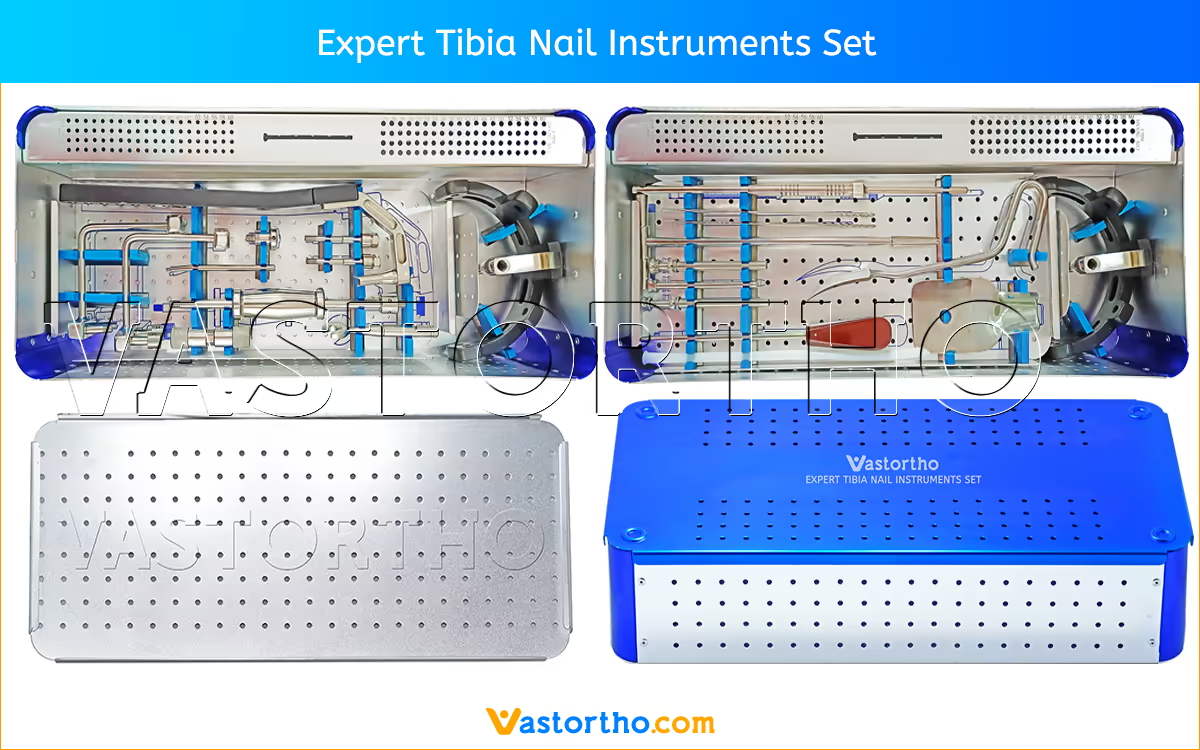
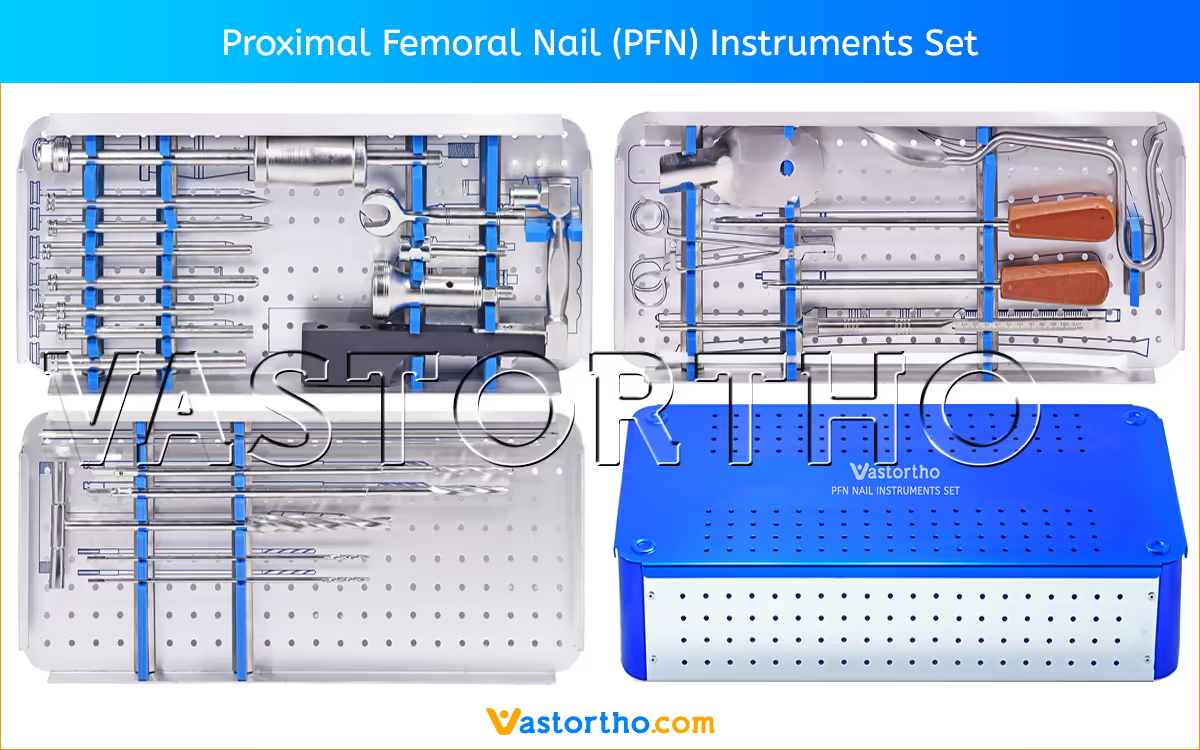
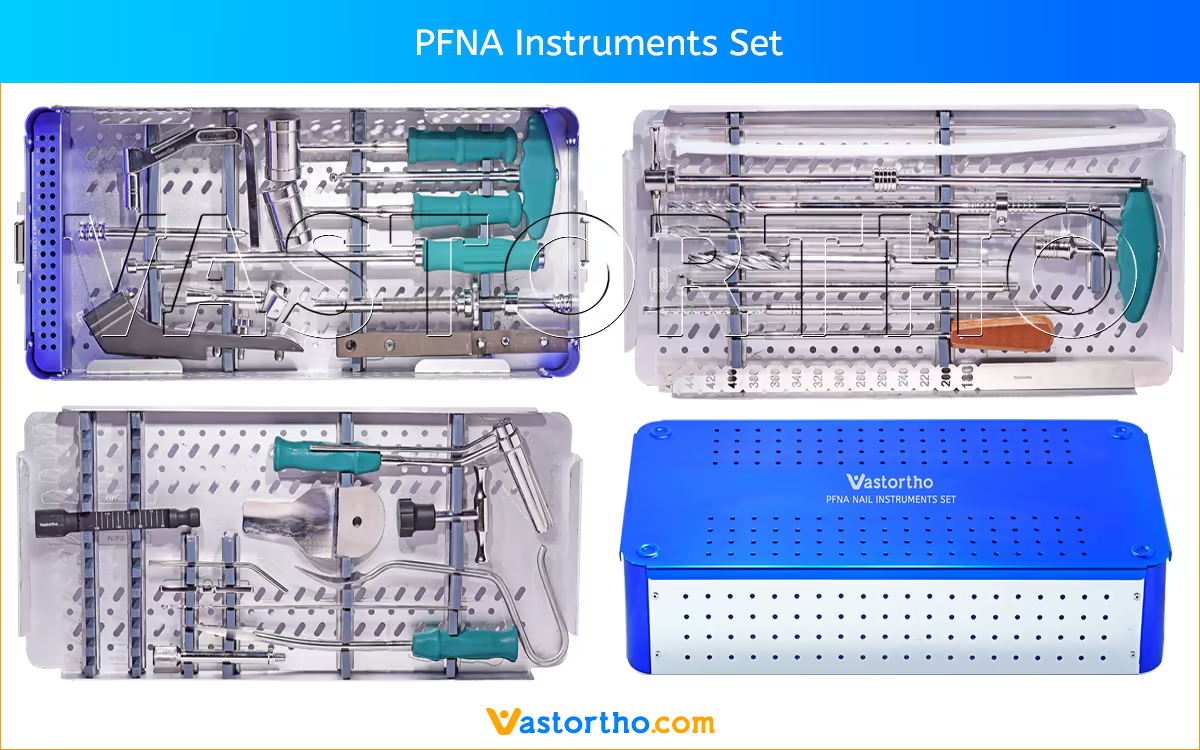
Humeral Nail Instrument Set – Complete Intramedullary Humeral Nail Instrument System
Precision-Engineered Radiolucent Targeting, Rotator-Cuff-Sparing Canal Entry, and Ascending Calcar Locking Instrumentation for Proximal and Diaphyseal Humeral Osteosynthesis.
Designed for hospital trauma centers, shoulder reconstruction specialists, and global surgical distributors, our Humeral Nail Instrument Set delivers rigid targeting accuracy and soft-tissue protection for simple and complex upper-extremity fractures. Engineered directly by an ISO 13485-certified Humeral Nail Instrument Set Manufacturer, this unified Intramedullary Humeral Nail Instrument System consolidates percutaneous canal opening, multi-planar tuberosity and calcar targeting, screw-in-screw aiming, and active diaphyseal compression into a single color-coded sterile platform. Whether your hospital value analysis team specifies a clinical Humeral Nail Instrument Set or your international tender requires an export-ready Humerus Nail Instrument Set, this system provides universal compatibility across modern straight and lateral-bend cannulated humeral nails.
- Short Proximal & Long Diaphyseal Compatibility: Supports both short proximal humeral nails (140mm) and long cannulated humeral shaft nails (180mm–320mm) across Ø 7.0mm to Ø 10.0mm diameters.
- Complete Upper-Extremity Trauma Coverage: Purpose-built as an all-in-one Proximal Humerus and Humeral Shaft Fracture Nailing System, guiding 3.9mm multi-planar proximal locking screws, 135° ascending medial calcar support screws, 3.9mm screw-in-screw locking pins, and 3.9mm distal interlocking screws.
- Rotator Cuff & Neurovascular Protection: Includes blunt-tipped concentric protection sleeves and calibrated depth-stop drills designed to shield the supraspinatus tendon, axillary nerve, radial nerve, and biceps tendon during percutaneous locking.
- Aiming Bow: Ensures unobstructed anteroposterior (AP), axillary, and scapular-Y C-arm fluoroscopy while maintaining zero mechanical deflection.
- Certified Surgical Metallurgy: Manufactured under ISO 13485:2016 certified quality management systems using stainless steel with medical silicone ergonomics.
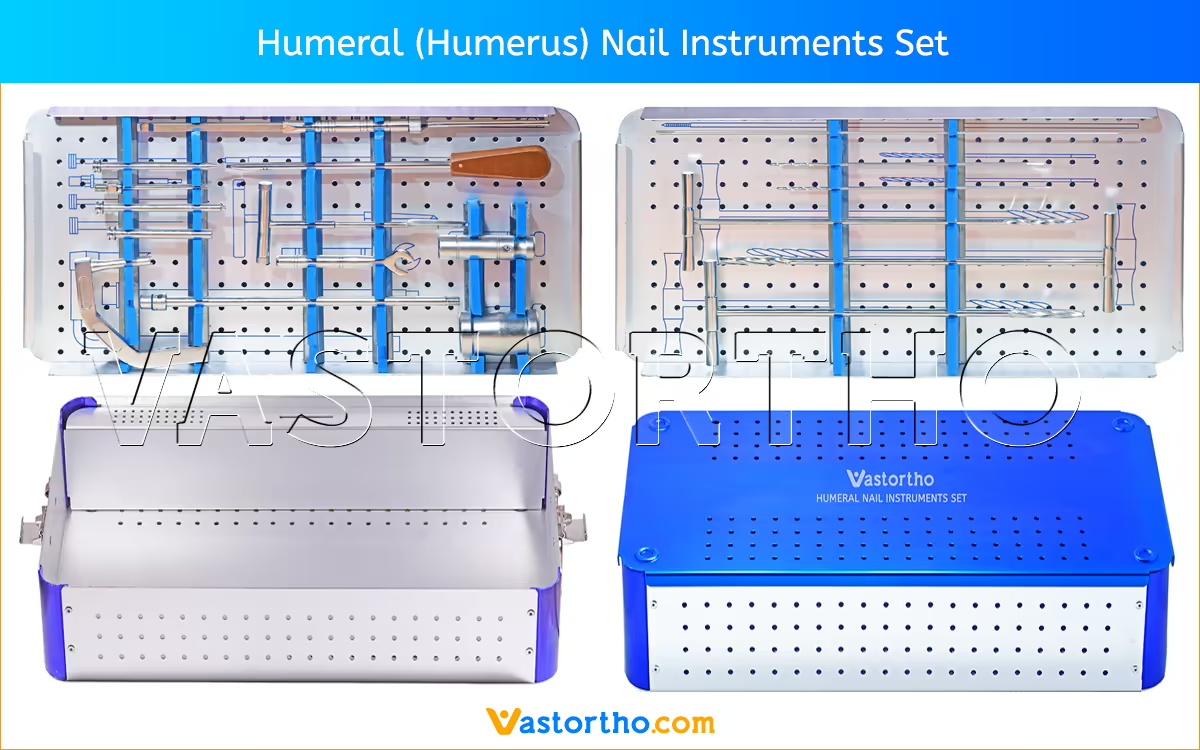
Standard Set Configuration – Humeral Nail Instrument Set
Below is the standard factory Bill of Materials for the Humeral Nail Instrument Set. Flexible medullary reamer sets, retrograde humeral aiming attachments, and custom OEM private-label laser markings are available upon request.
- Jig for Humerus Nail: 1 qty
- Conical Bolt for Jig: 1 qty
- Protection Sleeve: 1 qty
- Trocar: 1 qty
- Drill Sleeve: 1 qty
- Depth Gauge measuring upto 110 mm: 1 qty
- Screw Driver: 1 qty
- Bone Awl Cannulated: 1 qty
- Spanner: 1 qty
- Rod Handle: 1 qty
- Rod: 1 qty
- Ram: 1 qty
- 2 mm Guide Wire: 2 qty
- Drill Bit, 2.7 mm x 225 mm: 2 qty
- Reamer T handle Cannulated 6 mm: 1 qty
- Reamer T handle Cannulated 7 mm: 1 qty
- Reamer T handle Cannulated 8 mm: 1 qty
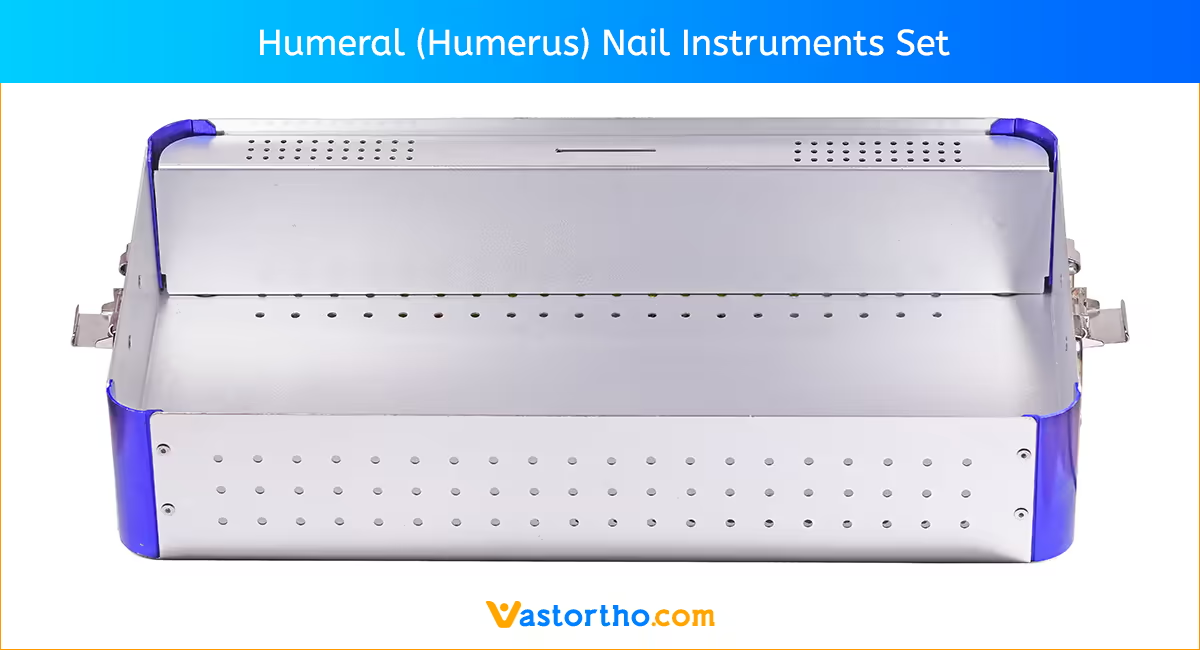
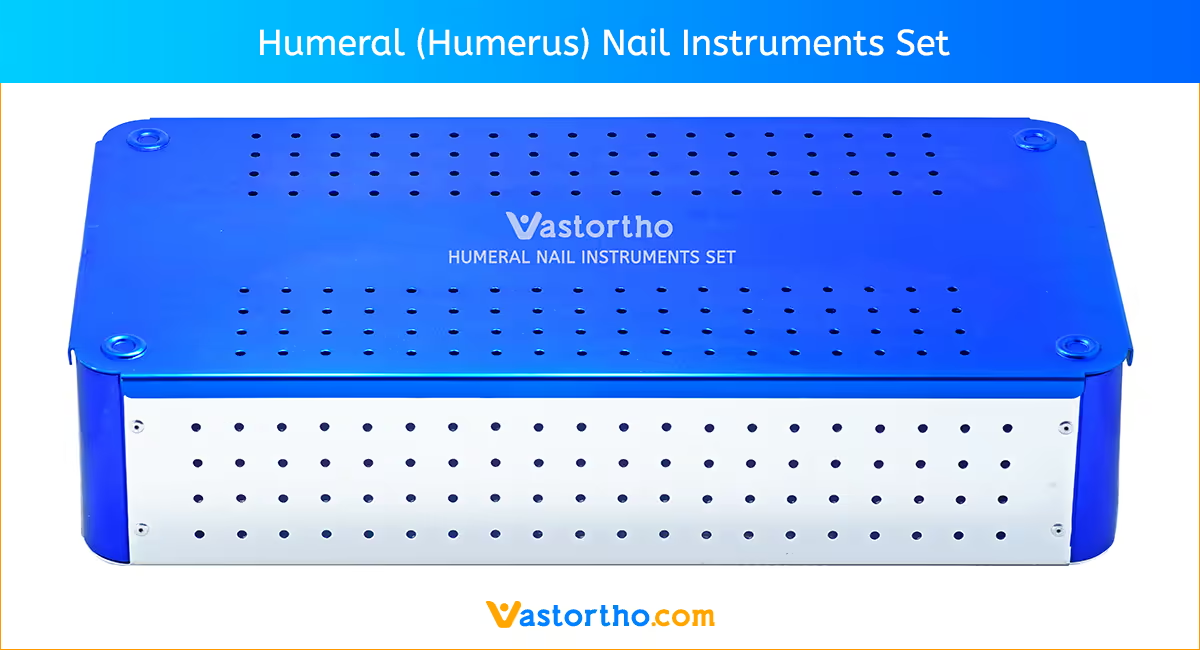
- Graphics Aluminium Box with Silicone Fittings: 1 qty
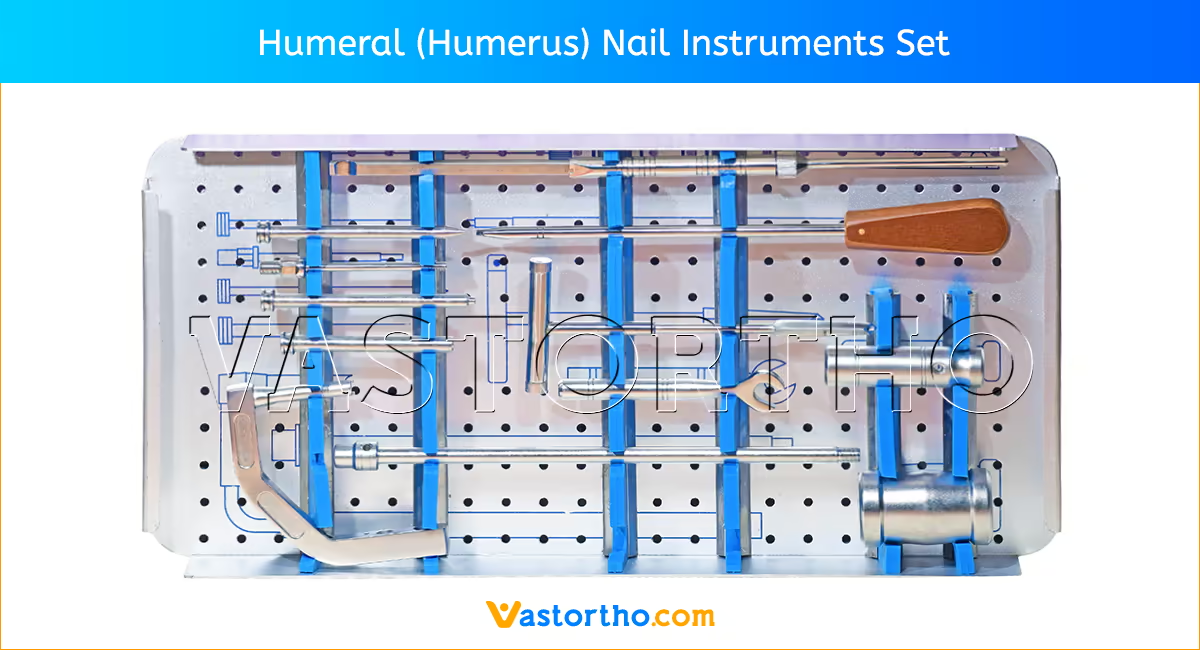
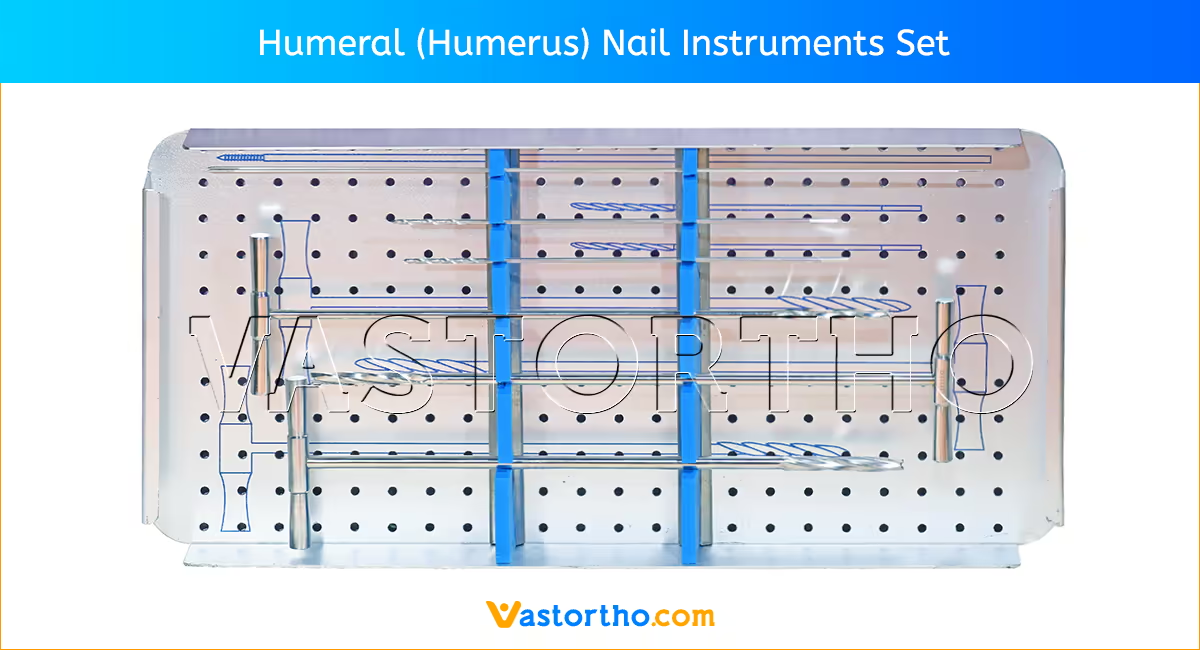
Dual-Length Surgical Versatility: Universal Humerus Nail Instrument Set for Short & Long Nails
Fractures of the proximal humerus and humeral diaphysis present unique anatomical hazards—including osteoporotic humeral head cavitation, rotator cuff impingement, and close proximity to the axillary and radial nerves. Stocking separate instrument trays for proximal shoulder fractures and mid-shaft humeral fractures creates unnecessary sterile processing overhead. Our universal Humerus Nail Instrument Set eliminates redundant inventory by accommodating both straight (central articular entry) and curved (greater tuberosity entry) nail geometries inside one modular layout.
Engineered as a comprehensive Intramedullary Humeral Nail Instrument System, the platform provides portal-specific entry and depth-verification tools:
- Countersunk Subchondral Nail Seating: The proximal nail connection mount features laser-etched radiographic alignment grooves, allowing the surgeon to countersink the proximal nail end beneath the subchondral bone cortex under fluoroscopy to prevent subacromial impingement.
- Multi-Wire Entry Portal Adjustment: Includes a multi-hole offset guide sleeve that slides over the initial Ø 2.5mm guide pin, allowing the surgeon to adjust the entry portal by 2.0mm or 4.0mm in any direction without losing the primary anatomical reference.
Biomechanical Targeting Engineering: Proximal Humerus and Humeral Shaft Fracture Nailing System
Stabilizing multi-fragmentary 3-part and 4-part proximal humeral fractures requires fixed-angle support of the Greater and Lesser Tuberosities alongside medial calcar buttressing. Configured as a high-precision Proximal Humerus and Humeral Shaft Fracture Nailing System, this platform provides five specialized mechanical targeting capabilities:
- 135° Ascending Calcar Screw Aiming Module: A detachable radiolucent aiming block locks onto the main targeting bow to guide an ascending oblique screw precisely along the inferomedial calcar cortex—preventing varus head collapse and posteromedial displacement.
- Visual & Tactile Bicortical Depth Drilling (Zero Joint Penetration): Calibrated Ø 3.2mm and Ø 2.8mm drills pair with a mechanical drill stop and a blunt-tipped subchondral feeler gauge (“push rod”), allowing the surgeon to palpate the far subchondral bone plate of the humeral head without perforating the glenohumeral articular surface.
- Active Internal Axial Compression (Up to 6mm): Incorporates a calibrated internal compression screw that threads into the driving mount to close transverse or short oblique humeral shaft fracture gaps against a dynamic distal screw.
- Jig-Guided Short Nail & Freehand Long Nail Distal Locking: Features distal anteroposterior (AP) and lateral aiming ports on the targeting arm for short nails, plus a radiolucent freehand targeting wand for safely placing AP and mediolateral distal screws in long humeral nails.
Clinical Indications Across AO/OTA 11 & 12 Upper-Extremity Fractures
By combining tuberosity-specific proximal targeting with long-shaft interlocking in one consolidated case, trauma centers and specialty shoulder units can address the complete spectrum of humeral pathology:
Proximal Humeral, Metaphyseal & Diaphyseal Shaft Applications
- 2-Part, 3-Part & 4-Part Proximal Humerus Fractures (AO/OTA 11-A, 11-B & 11-C): Surgical neck fractures and displaced greater/lesser tuberosity fractures stabilized using blunt-tipped proximal locking screws, suture-hole augmentation, and ascending calcar support.
- Proximal Humerus Fractures with Diaphyseal Extension: Combined metaphyseal-diaphyseal spiral fractures managed seamlessly with long nails using our Proximal Humerus and Humeral Shaft Fracture Nailing System.
- Diaphyseal Humeral Shaft Fractures (AO/OTA 12-A, 12-B & 12-C): Transverse, oblique, spiral wedge, and segmental mid-shaft fractures stabilized via closed antegrade interlocking and active axial compression.
- Pathological Fractures, Nonunions & Malunions: Prophylactic intramedullary stabilization of metastatic humeral lesions and revision exchange nailing for humeral shaft nonunions.
Sterile Processing (SPD) Efficiency & Modular Graphic Case Architecture
Hospital Sterile Processing Departments (SPD) and operating room managers evaluate upper-extremity nailing systems on autoclave reliability, ergonomic weight limits, and rapid visual inventory counts. Our Humeral Nail Instrument Set is housed in a perforated, hard-anodized aluminum sterilization container with silicone holders.
- High-Flow Steam Perforation Geometry: Engineered with an open-surface perforation ratio exceeding 45% to guarantee rapid steam penetration and moisture evacuation during standard pre-vacuum steam sterilization cycles (132°C / 270°F for 4 minutes).
- Ergonomic Modular Split-Tray Design: Heavy driving hammers, conical reamers, and targeting jigs in Humeral Nail Instrument Set are distributed across balanced, stackable modular tiers so the loaded sterilization case remains strictly below the 25 lb (11.3 kg) AAMI ST77 limit.
Direct OEM & Global Supply: Certified Humeral Nail Instrument Set Manufacturer
Sourcing upper-extremity intramedullary targeting systems directly from a dedicated Humeral Nail Instrument Set Manufacturer eliminates third-party distributor markups and guarantees micron-level coaxial alignment between your targeting jigs and humeral nail implants. Because proximal screw-in-screw and ascending calcar trajectories require ultra-tight angular tolerances, every aiming bow and cam-lock module is verified on measuring machines and test-fitted against master implant gauges prior to shipment.
- Cutting & Drilling Metallurgy: Conical step reamers, awls, taps, and calibrated twist drill bits are machined from Custom hardened surgical steel, vacuum heat-treated to 48–52 HRC for enduring flute sharpness and wear resistance.
- Custom OEM Jig-to-Implant Calibration: As a full-service Humeral Nail Instrument Set Manufacturer, we calibrate proximal aiming bows and calcar modules to match universal MultiLoc-style straight nail geometry, lateral-bend UHN/T2 geometry, or your proprietary implant blueprint.
- Global Regulatory & Tender Compliance: Manufactured in an ISO 13485:2016 certified facility.
Frequently Asked Questions
Q1: Is there any difference between a Humeral Nail Instrument Set and a Humerus Nail Instrument Set?
In clinical orthopedic terminology and global B2B procurement, Humeral Nail Instrument Set and Humerus Nail Instrument Set refer to the exact same surgical system. Our unified platform meets both Western clinical operating room standards and international hospital tender RFQ specifications for intramedullary humeral osteosynthesis.
Q2: Does this Intramedullary Humeral Nail Instrument System support both straight and curved humeral nails?
Yes. Engineered as a versatile Intramedullary Humeral Nail Instrument System, the radiolucent aiming arm and entry instrumentation support both modern straight proximal humeral nails (inserted through the central humeral head zenith to spare the rotator cuff tendon) and traditional 5° – 6° lateral-bend nails.
Q3: How does the Proximal Humerus and Humeral Shaft Fracture Nailing System prevent humeral head screw perforation?
Our Proximal Humerus and Humeral Shaft Fracture Nailing System utilizes calibrated drill bits with mechanical depth stops paired with a graduated blunt-tipped subchondral feeler gauge (“push rod”). This allows the surgeon to drill only the lateral cortex and palpate the far subchondral bone plate of the humeral head without piercing the articular cartilage.
Q4: What are the sterilization parameters for the Humeral Nail Instrument Set container?
The anodized aluminum sterilization container is validated for standard hospital pre-vacuum steam autoclave sterilization at (132°C / 270°F) for 4 minutes with a minimum 20–30 minute drying cycle, as well as 134°C (273°F) for 3 minutes under European/WHO sterilization protocols.
Q5: As a Humeral Nail Instrument Set Manufacturer, do you offer OEM private-label branding and custom jig calibration?
Yes. As a direct Humeral Nail Instrument Set Manufacturer, we provide comprehensive OEM and private-label services for orthopedic implant companies and regional distributors, including custom laser-etched brand logos, bespoke anodized case colors, tailored silicone bracket layouts, and custom targeting jig calibration.
Do you have any questions for Humeral (Humerus) Nail Instrument Set?
Please fill this form we will get in touch with you shortly.