Cervical Cage Instrument Set for ACDF Procedures

Spine Cervical Cage Instruments Set

A Cervical Cage Instrument Set is a specialized collection of surgical instruments designed to support the preparation, insertion, positioning, and handling of cervical interbody cages during cervical spine procedures. These instruments are commonly used in anterior cervical approaches where an interbody device is placed into the prepared disc space.

These sets are commonly required by spine surgeons, hospitals, surgical centers, medical device companies, and orthopedic instrument distributors supporting anterior cervical discectomy and fusion (ACDF). the configuration of the instrument set is an important consideration. The appropriate system should provide instruments that correspond to the intended cage design and surgical technique while supporting controlled handling and efficient workflow.

What Is a Cervical Cage Instrument Set?

A Cervical Cage Instrument Set is a coordinated collection of instruments intended for use with a specified cervical interbody cage system. It supports the principal stages of cage placement, including disc-space access, endplate preparation, trial sizing, implant loading, insertion, positioning, and—when provided for by the system—implant removal or revision.

These instruments do not replace the cage implant itself. They are selected or manufactured to match the implant’s geometry, connection interface, permitted insertion method, and surgical technique. Consequently, an inserter or trial from one cervical cage platform should not be assumed to work with another system unless compatibility has been formally established.

An anterior cervical cage instrument set may form part of a broader cervical spine instrumentation portfolio that also includes access, distraction, decompression, plating, or fixation instruments.

Purpose and Typical Surgical Applications

Cervical interbody cage instruments are primarily associated with anterior cervical procedures in which a diseased or damaged disc is removed and an interbody implant is placed between adjacent vertebral bodies.
Typical applications may include

  • Supporting anterior cervical discectomy and fusion workflows
  • Preparing the intervertebral space for a compatible cage
  • Evaluating implant height, footprint, and lordotic profile with trials
  • Packing graft material into a cage when required by the implant design
  • Delivering and positioning the selected implant
  • Supporting integrated fixation steps for applicable stand-alone cage systems
  • Removing or revising an implant when compatible extraction instruments are available

The implant’s indications, operative technique, and regulatory status are separate from those of the reusable instrumentation. Surgeons and healthcare facilities must use each system according to its current instructions for use and applicable local requirements.

Instruments Included in a Cervical Cage Set

Below are list of Instruments Included in a Cervical Cage Set (ACDF cage instrument set)

Spine Cervical Cage Instruments Set 1

Spine Cervical Cage Instruments Set 2

  • Trial Cage 5 mm – 1 Qty
  • Trial Cage 6 mm – 1 Qty
  • Trial Cage 7 mm – 1 Qty
  • Trial Cage 8 mm – 1 Qty
  • Trial Cage 9 mm – 1 Qty
  • Trial Cage 10 mm – 1 Qty
  • Bone Pusher Half Round – 1 Qty
  • Slotted Hammer – 1 Qty
  • Trial Cage Holder – 1 Qty
  • Cage Holder For Trial Cage – 1 Qty
  • Bone Curette Straight – 1 Qty
  • Bone Curette Curved – 1 Qty
  • Bone Grafting Impactor – 1 Qty
  • Graphics Aluminium Box with Silicone Fittings – 1 Qty

Disc-Space Preparation Instruments

Curettes, scrapers, rasps, pituitary rongeurs, or other preparation tools may be used to remove disc material and prepare the space according to the surgical technique. Some systems provide rasps that correspond to specific cage footprints or profiles.

Preparation instruments should support controlled handling while allowing the surgeon to work within the confined anterior cervical surgical corridor. Their dimensions and cutting or scraping features must be appropriate for the intended system.

Cervical Trial Sizers

Trial implants help evaluate the cage dimensions before the definitive implant is opened or inserted. A trial range may offer different:

Heights
Widths and depths
Footprints
Lordotic angles
Anatomical profiles

Trials should be clearly identified so operating-room personnel can distinguish sizes efficiently. Their geometry should correspond to the compatible implant family, including any dimensional differences defined by the manufacturer.

Cage Inserters

The interbody cage inserter connects to the implant and supports controlled delivery into the prepared disc space. Depending on the cage design, the connection may use threads, jaws, slots, pins, or another dedicated interface.

Important considerations include connection security, visibility, shaft alignment, handle ergonomics, and the method used to release the implant. Angled or offset inserters may be offered when compatible with the surgical technique.

Impactors and Positioning Instruments

A cage impactor or tamp may allow controlled advancement or final adjustment after initial insertion. Stops, depth references, or low-profile tips may be incorporated depending on the system.

Any instrument that directly contacts the implant must be designed to avoid unintended damage to the cage or disruption of the intended interface.

Important Instrument Features

A well-configured cervical cage insertion instrument set should support predictable instrument identification, handling, compatibility, and reprocessing. Buyers may assess the following features:

  • Secure engagement between the cage and inserter
  • Trial sizes corresponding to the implant range
  • Clear, durable size and instrument markings
  • Handles suitable for controlled grip and manipulation
  • Appropriate shaft length and working profile
  • Accessible surfaces for cleaning and inspection
  • Instrument organization within a dedicated tray
  • Replaceable or separately orderable high-wear components
  • Compatibility information for each instrument and implant
  • Defined assembly, disassembly, and reprocessing instructions

Features should be evaluated against the relevant surgical technique. A larger instrument count does not automatically make a set more suitable; unnecessary duplication can complicate inventory, tray weight, inspection, and reprocessing.

Instrument Design and Functionality

Cervical procedures are performed through a relatively constrained operative corridor. Instrument geometry should therefore balance access, control, visualization, and mechanical strength.

Inserters require accurate alignment with the implant interface. Trials need consistent dimensional relationships with their corresponding cage sizes. Impactors must transmit force in the intended direction, while release mechanisms should allow the inserter to disengage without unwanted implant movement.

For reusable cervical fusion cage instruments, design teams should also consider cleaning access. Joints, sleeves, internal threads, narrow gaps, and detachable components may retain surgical soil if the reprocessing method is not appropriately designed and validated. Where disassembly is required, instructions and instrument markings should make the process clear to sterile-processing personnel.

Materials and Manufacturing Considerations

Reusable cervical cage instruments are commonly manufactured from medical-device-grade stainless steel, although material selection may vary by instrument function. Manufacturers may also use, silicone components, or other suitable materials in handles and non-working features.
Important production considerations include:

  • Material suitability for the intended mechanical load
  • Dimensional control at implant-connection interfaces
  • Corrosion-resistant finishing and passivation, where applicable
  • Smooth, cleanable surfaces
  • Legible laser marking or another durable identification method
  • Controlled heat treatment for applicable components
  • Inspection of threads, jaws, cutting features, and moving parts
  • Lot or batch traceability under the manufacturer’s quality system
  • Packaging and tray features that protect instruments during transport and processing

Available Configurations and Supply Options

A Cervical Cage Instrument Set may be supplied as a complete system, a procedure-focused subset, or individual replacement instruments. Available options may include:

  • Multiple trial heights and footprints
  • Parallel or lordotic trial profiles
  • Straight, angled, or offset inserters
  • Standard and compact tray configurations
  • Instrument-only sets for established implant platforms
  • Integrated-fixation modules
  • Revision or extraction instruments
  • Demonstration sets where permitted
  • Replacement components and additional trays

Configuration should follow the compatible cage range and intended surgical technique. Buyers should check a detailed instrument list before comparing quotations.

Advantages for Hospitals, Surgeons, and Distributors

A logically arranged set can help operating-room teams identify instruments, verify completeness, and prepare the required devices for a procedure. Matching trials and inserters to the implant platform also reduces uncertainty about system compatibility.

For hospitals and procurement teams, a defined instrument list supports inventory control, replacement planning, and coordination with sterile processing. Distributors benefit from clear product references, tray layouts, compatibility documentation, and spare-part availability.

Medical device companies developing a cage platform may use an OEM instrument partner to coordinate instrument design, manufacturing, marking, tray organization, and packaging.

Cleaning, Sterilization, and Maintenance

Reusable instruments must be reprocessed according to the validated instructions for use. The appropriate procedure can differ by design, material, construction, and market authorization.

Facilities should pay particular attention to implant-engagement features, threads, joints, cannulations, sleeves, and other areas where debris may collect. Instruments that require disassembly should be separated only as instructed. After cleaning, each device should be inspected for corrosion, deformation, damaged working ends, illegible markings, impaired movement, and secure assembly.

Sterilization parameters should never be inferred from the instrument’s appearance or material. Use only the validated method, cycle, packaging configuration, and loading conditions.

Request a Quotation for a Cervical Cage Instrument Set

Contact us to discuss a standard or customized Cervical Cage Instrument Set for your implant platform, hospital supply program, or distribution portfolio. To receive a relevant proposal, provide the cage design or system reference, required trial sizes, preferred inserter type, additional preparation or fixation instruments, tray requirements, estimated quantity, destination market, and any OEM documentation needs.

Our team can review the requested configuration and provide information about feasibility, available options, lead-time considerations, and quotation requirements.

Frequently Asked Questions

What instruments are included in a Cervical Cage Instrument Set?

A typical set may contain disc-space preparation instruments, trial sizers, cage inserters, impactors, graft-packing tools, and an instrument tray. Extractors may also be supplied. If the cage incorporates integrated fixation, the set may require awls, drill guides, drill bits, depth-control instruments, and screwdrivers. Contents vary according to the implant and surgical technique.

Is an ACDF cage instrument set universal?

No. Cervical cage instruments are generally designed around a specific implant system. Inserter connections, trial dimensions, cage profiles, and fixation instruments can differ between platforms. Compatibility should be confirmed through technical documentation and appropriate verification before the instruments are supplied or used.

Can the instrument set be customized for an existing cage?

Customization may be possible when adequate implant-interface data, drawings, dimensions, and surgical requirements are available. Development may involve a dedicated inserter, matching trials, impactors, extraction tools, and a customized tray. The responsible parties must determine the testing, validation, documentation, and regulatory work required for the intended markets.

What material is used for cervical cage instruments?

Reusable surgical instruments are commonly made from suitable grades of stainless steel. Other materials may be used for handles, grips, or specialized components. The appropriate material depends on mechanical requirements, corrosion resistance, reprocessing compatibility, and device design. Buyers should request the actual material specification from the manufacturer.

Are cervical fusion cage instruments reusable?

Many cervical cage instruments are designed as reusable devices, but this must be confirmed from their labeling and instructions for use. Reusable instruments require validated cleaning and sterilization procedures, routine inspection, correct maintenance, and removal from service when damaged or no longer functional. An instrument should not be treated as reusable without supporting instructions.

Are cervical cage instruments supplied with the implants?

Supply arrangements differ. Instruments may be sold as a complete set, provided through a loaner program, or ordered independently from the implants. The implant, reusable instruments, disposable accessories, and sterilization tray may also have separate product references. Buyers should request an itemized scope with the quotation.

What should be included in a quotation request?

Provide the implant-system name or cage drawings, available implant dimensions, required trial sizes, inserter connection, need for integrated-fixation instruments, tray preferences, expected order quantity, destination country, and OEM or private-label requirements. This information helps the supplier evaluate compatibility, development scope, documentation needs, and pricing.

Do you have any questions for Cervical Cage Instruments Set?
Please fill this form we will get in touch with you shortly.

This field is for validation purposes and should be left unchanged.
Name(Required)

More Products from Orthopedic Instruments Set

Anterior Cervical Plate Instruments Set

Anterior Cervical Plate Instrument Set

May 23, 2026/by VastOrtho
Spine Cervical Cage Instruments Set

Cervical Cage Instrument Set

May 12, 2026/by VastOrtho
Mini Fragment Instruments Set

Mini Fragment Instruments Set

February 5, 2021/by VastOrtho
2.4 mm Locking Instruments Set

2.4 mm Locking Instruments Set

February 4, 2021/by VastOrtho
2.7 mm Locking Instruments Set

2.7 mm Locking Instruments Set

February 3, 2021/by VastOrtho
Distal Radius Instruments Set

Distal Radius Instruments Set

February 2, 2021/by VastOrtho
Small Fragment Instruments Set

Small Fragment Instruments Set

February 2, 2021/by VastOrtho
3.5 mm Locking Instruments Set

3.5 mm Locking Instruments Set

February 1, 2021/by VastOrtho
Large Fragment Instruments Set

Large Fragment Instruments Set

January 30, 2021/by VastOrtho
5 mm Locking Instruments Set

5 mm Locking Instruments Set

January 29, 2021/by VastOrtho
4.5 mm Locking Instruments Set

4.5 mm Locking Instruments Set

January 28, 2021/by VastOrtho
Dynamic Hip Screw Instruments Set

Dynamic Hip Screw Instruments Set

January 27, 2021/by VastOrtho
Interlocking Nail Instruments Set

Interlocking Nail Instruments Set

January 26, 2021/by VastOrtho
Tibia Nail Instruments Set

Tibia Nail Instruments Set

January 26, 2021/by VastOrtho
Tibia Nail Instruments Set

Tibial Nail Instruments Set

January 26, 2021/by VastOrtho
Expert Tibia Nail Instruments Set

Expert Tibia Nail Instruments Set

January 25, 2021/by VastOrtho
Femur Nail Instruments Set

Femur Nail Instruments Set

January 25, 2021/by VastOrtho
PFN Nail Instruments Set

PFN Nail Instruments Set

January 24, 2021/by VastOrtho
PFNA2 Instruments Set

PFNA2 Instruments Set

January 23, 2021/by VastOrtho
PFNA Instruments Set

PFNA Instruments Set

January 22, 2021/by VastOrtho
Gamma Nail Instruments Set

Gamma Nail Instruments Set

January 21, 2021/by VastOrtho
Humeral Humerus Nail Instruments Set

Humeral (Humerus) Nail Instruments Set

January 20, 2021/by VastOrtho

Titanium Elastic Nail Instruments Set

January 18, 2021/by VastOrtho
TENS Nail Instruments Set

TENS Nail Instruments Set

January 17, 2021/by VastOrtho
Kuntscher Nail Instruments Set

Kuntscher Nail (K Nail) Instruments Set

January 16, 2021/by VastOrtho
Herbert Screws Instruments Set

Herbert Screws Instruments Set

January 13, 2021/by VastOrtho
Headless Screws Instruments Set

Headless Screws Instruments Set

January 13, 2021/by VastOrtho
4 mm Cannulated Cancellous Screws Instruments Set

4 mm Cannulated Screws Instruments Set

January 13, 2021/by VastOrtho
6.5 mm Cannulated Cancellous Screws Instruments Set

6.5mm Cannulated Screws Instruments Set

January 12, 2021/by VastOrtho
Spine Instruments Set

Spine Instruments Set

January 11, 2021/by VastOrtho
Pedicle Screws Instruments Set

Pedicle Screws Instruments Set

January 10, 2021/by VastOrtho
Laminectomy Instruments Set

Laminectomy instruments set

January 5, 2021/by VastOrtho
Bipolar Instruments Set

Bipolar Instruments Set

January 4, 2021/by VastOrtho
Angle Blade Plate Instruments Set

Angle Blade Plate Instruments Set

January 3, 2021/by VastOrtho
Austin Moore Instruments Set

Austin Moore Instruments Set

January 2, 2021/by VastOrtho
Broken Screw Removal Instruments Set

Broken Screw Removal Set

January 1, 2021/by VastOrtho
Mini Locking Instruments Set

Mini Locking Instruments Set

January 19, 2019/by VastOrtho
Small Locking Instruments Set

Small Locking Instruments Set

January 18, 2019/by VastOrtho
Large Locking Instruments Set

Large Locking Instruments Set

January 17, 2019/by VastOrtho
Femoral Nail Instruments Set

Femoral Nail Instruments Set

January 9, 2019/by VastOrtho
PFNA II Instruments Set

PFNA-II Instruments Set

January 8, 2019/by VastOrtho
Polyaxial Screws Instruments Set

Polyaxial Screws Instruments Set

January 7, 2019/by VastOrtho

Cervical Cage Instrument Set Contraindications

Contraindications may be qualified or total, and need to be taken into consideration when evaluating the prognosis in each case. Alternative management techniques may need to be considered under the following conditions:

  • Acute or chronic infections, either local or systemic.
  • Local or systemic accurate or chronic inflammation.
  • Serve muscular, nervous or vascular disease endangering the affected area.
  • Defective bone structures, which would impede adequate anchoring of the implant.
  • All associated diseases which could endanger the function and success of the implant.

Warnings and Precautionary for Cervical Cage Instrument Set

Before using Cervical Cage Instrument Set, the surgeon and ancillary staff should study the safety information in these instructions, as well as any product-specific information in the product description, surgical procedures and/or brochures.

Instruments are made from medical grade materials and are designed, constructed and produced with utmost care. These quality Instruments assure best working results provided they are used in the proper manner. Therefore, the following instructions for use and safety recommendations must be observed.

Improper use of Instruments can lead to damage to the tissue, premature wear, destruction of the instruments and injury to the operator, patients or other persons.

It is vital for the operating surgeon to take an active role in the medical management of their patients. The surgeon should thoroughly understand all aspects of the surgical procedure and instruments including their limitations. Care in appropriate selection and proper use of surgical instruments is the responsibility of the surgeon and the surgical team. Adequate surgical training should be completed before use of Cervical Cage Instrument Set.

Factors which could impair the success of the operation:

  • Allergies to implanted materials.
  • Localized bone tumours.
  • Osteoporosis or osteomalacia.
  • System disease and metabolic disturbances.
  • Alcohol and drug abuse.
  • Physical activities involving excessive shocks, whereby the implant is exposed to blows and/or excessive loading.
  • Patients who are mentally unable to understand and comply with the doctor’s instructions.
  • Poor general health.

Possible Adverse Effects

The following adverse effects are the most common resulting from implantation:

  • Loosening of the implants, which may result from cyclic loading of the fixation site and/or tissue reaction of the implant.
  • Early and late infection.
  • Further bone fracture resulting from unusual stress or weakened bone substance.
  • Temporary or chronic neural damage resulting from pressure or hematomata.
  • Wound hematomas and delayed wound healing.
  • Vascular disease including venal thrombosis, pulmonary embolism and cardiac arrest.
  • Heterotopic ossification.
  • Pain and discomfort due to presence of the implants.
  • Mechanical failure of the implant, including bending, loosening or breakage.
  • Migration of implant resulting in injury.

Preoperative Planning for Cervical Cage Instrument Set

The operating planning is carried out following a thorough clinical evaluation of the patient, Also, x-rays must be taken to allow a clear indication of the bony anatomy and associated deformities. At the time of the operation, the corresponding implantation instruments in addition to a complete set of Cervical Cage Instrument Set must be available.

The clinician should discuss with the patient the possible risks and complications associated with the use of implants. It is important to determine pre-operatively whether the patient is allergic to any of the implant materials. Also, the patient needs to be informed that the performance of the device cannot be guaranteed as complications can affect the life expectancy of the device.

Cervical Cage Instrument Set Precautions

  • Confirm functionality of Cervical Cage Instrument Set and check for wear during reprocessing. Replace worn or damaged instruments prior to use.
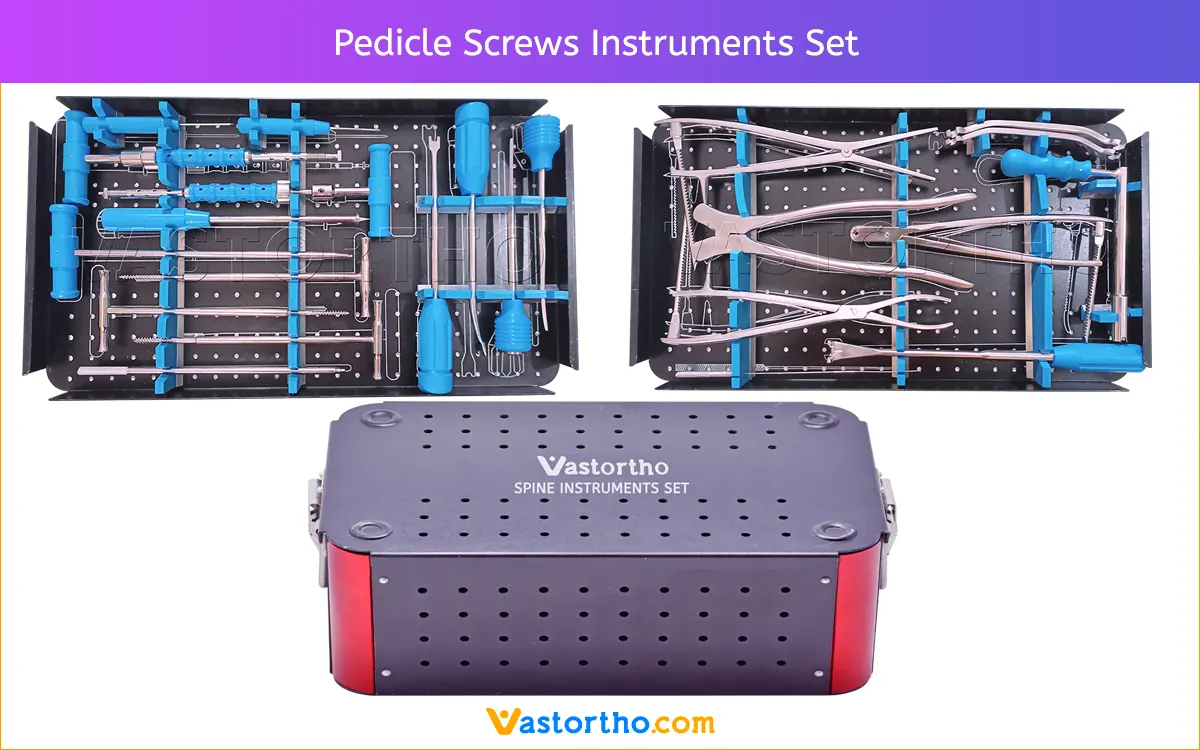
  • It is recommended to use the Pedicle Screws Instruments Set identified for particular implants.
  • Handle devices with care and dispose worn bone cutting instruments in a sharps container.
  • Always irrigate and apply suction for removal of debris potentially generated during implantation or removal.

Cervical Cage Instrument Set Warnings

  • Few Instruments from this set can break during use (when subjected to excessive forces). While the surgeon must make the final decision on removal of the broken part based on associated risk in doing so, we recommend that whenever possible and practical for the individual patient, the broken part should be removed. Be aware that implants are not as strong as native bone. Implants subjected to substantial loads may fail.
  • Cervical Cage Instrument Set may have sharp edges or moving joints that may pinch or tear user’s glove or skin.
  • Take care to remove all fragments that are not fixated during the surgery.
  • While the surgeon must make the final decision on implant removal, we recommend that whenever possible and practical for the individual patient, fixation devices should be removed once their service as an aid to healing is accomplished. Implant removal should be followed by adequate post-operative management to avoid refracture.

Cervical Cage Instrument Set General Adverse Events

As with all major surgical procedures, risks, side effects and adverse events can occur. While many possible reactions may occur, some of the most common include: Problems resulting from anesthesia and patient positioning (e.g. nausea, vomiting, dental injuries, neurological impairments, etc.), thrombosis, embolism, infection, nerve and/or tooth root damage or injury of other critical structures including blood vessels, excessive bleeding, damage to soft tissues incl. swelling, abnormal scar formation, functional impairment of the musculoskeletal system, pain, discomfort or abnormal sensation due to the presence of the device, allergy or hypersensitivity reactions, side effects associated with hardware prominence, loosening, bending, or breakage of the device, mal-union, non-union or delayed union which may lead to breakage of the implant, reoperation.

Instruments

Bone Plates

Other Implants

Bone Screws

© Vast Ortho: Orthopedic Implants Manufacturers
First Floor, Khasra No. 104/14 | B-Block, Sant Nagar, Burari | Delhi-110084, INDIA